
September 2026 News
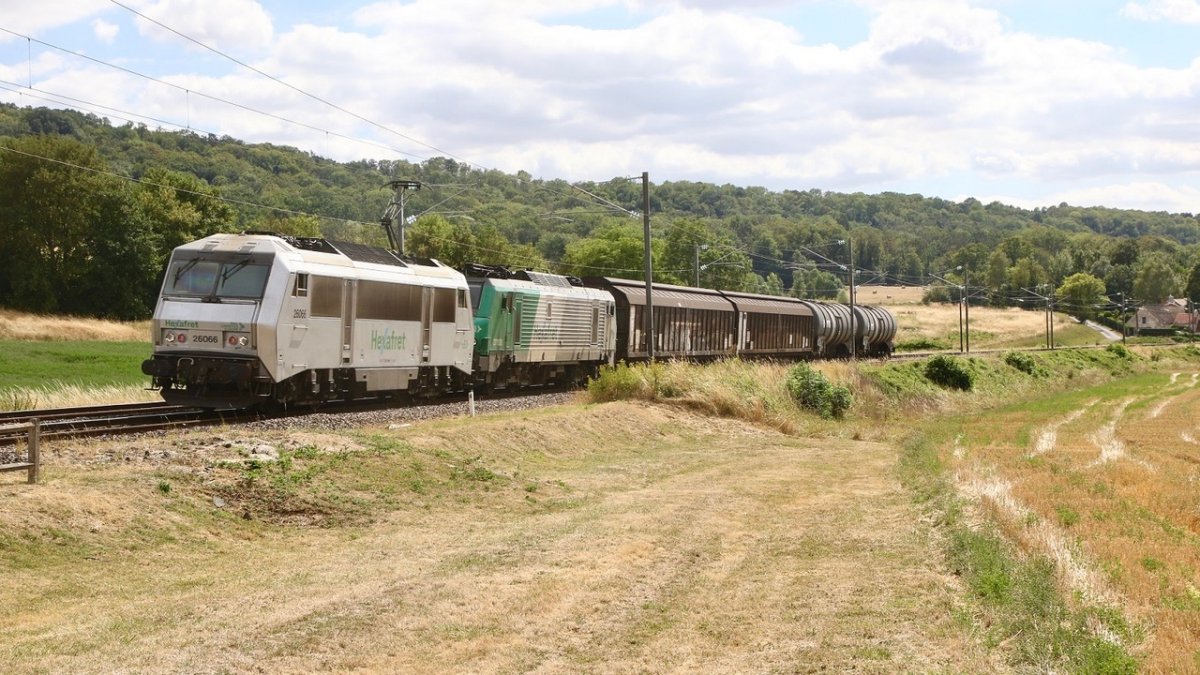
Can France still maintain marginal freight flows and cross-subsidise TGV passenger services in a liberalised rail market, where private operators are only interested in profitable routes? The issues are raised as a private investor is sought for SNCF's freight business and the government grapples with providing TGV services for social and regional need (see reports below). Above. On 27 July Hexafret BB 26066 with BB 27100 dead in tow passes Fossoy (Aisne) between Château-Thierry and Mézy with a lightly loaded 49263 Brétigny - Stiring-Wendel service. Photo. Georges Turpin.
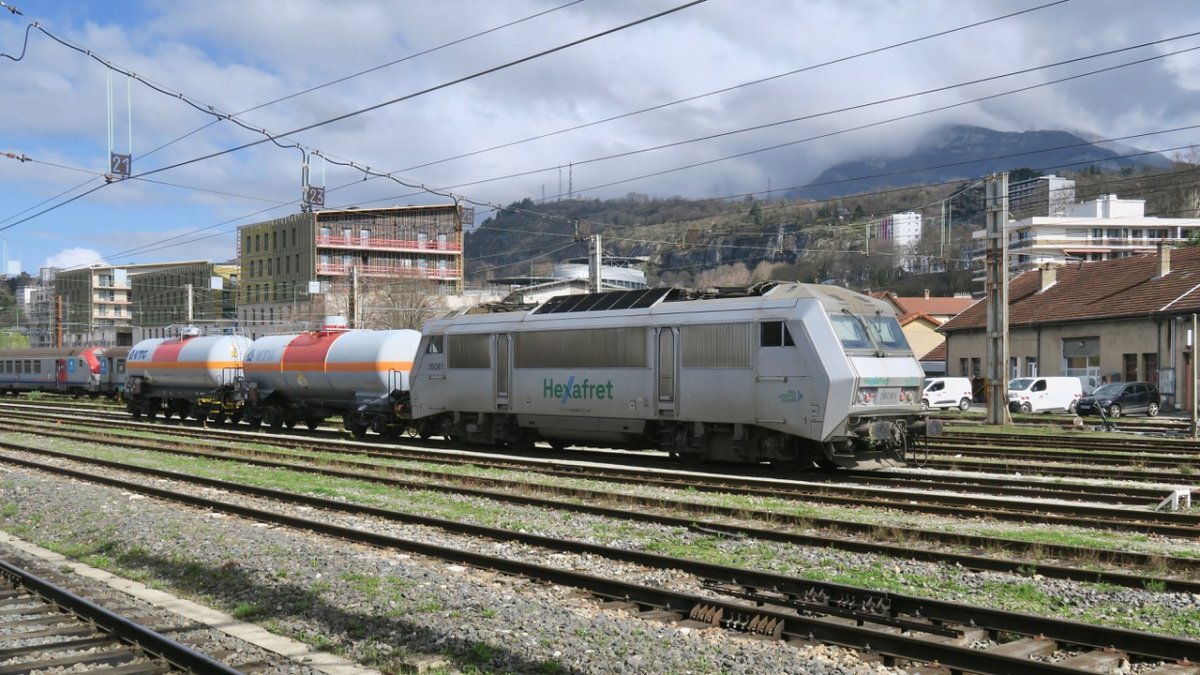
Hexafret is the only operator in France interested in wagonload and mixed freight, with liquid gas being one of the main cargoes. On 11 March BB 26061 waits in the yard at Chambéry with a short trip working of LPG tanks.
Rail Logistics Europe seeks minority investor
RLE (Rail Logistics Europe), the freight arm of SNCF Groupe, is seeking a minority investor willing to purchase 49% of its equity. The move is one of the final conditions imposed by the EU in the 'economic discontinuance' of Fret SNCF. This was mandated due to unlawful subsidies made by the government under SNCF's previous governance structure when Fret SNCF was a subsidiary of Geodis and accounting procedures were more opaque.
RLE was restructured from January 2025, having had to hand over some 20 key domestic flows to rival operators as part of the discontinuance. It remains one of Europe's largest freight operators, with six subsidiaries or brands:
Naviland Cargo – Maritime container traffic.
VIIA – Rolling motorway for containers and semi-trailer traffic.
Forwardis – Rail and forwarding logistics for bulk loads.
Captrain – Cross border and international corridor traffic.
Hexafret – Mixed traffic and smaller flows.
Technis – Locomotive servicing, maintenance and repair for RLE and other operators.
Turnover for the group during the first half of the year was €948 million, an increase of 3.9% on the previous year.
Interested investors are believed to include German logistics company Rhenus and Daniel Křetínský’s Czech-based EP Group which owns Royal Mail and a range of logistics interests across Europe. French shipping and logistics company CMA CGM was initially interested, but only in the intermodal and container elements and has since pulled out. It was believed to be looking to meet the expansion of competitor MSCwhich has recently expanded its Medway freight activities in France. The exercise is expected to be completed by the end of this year.
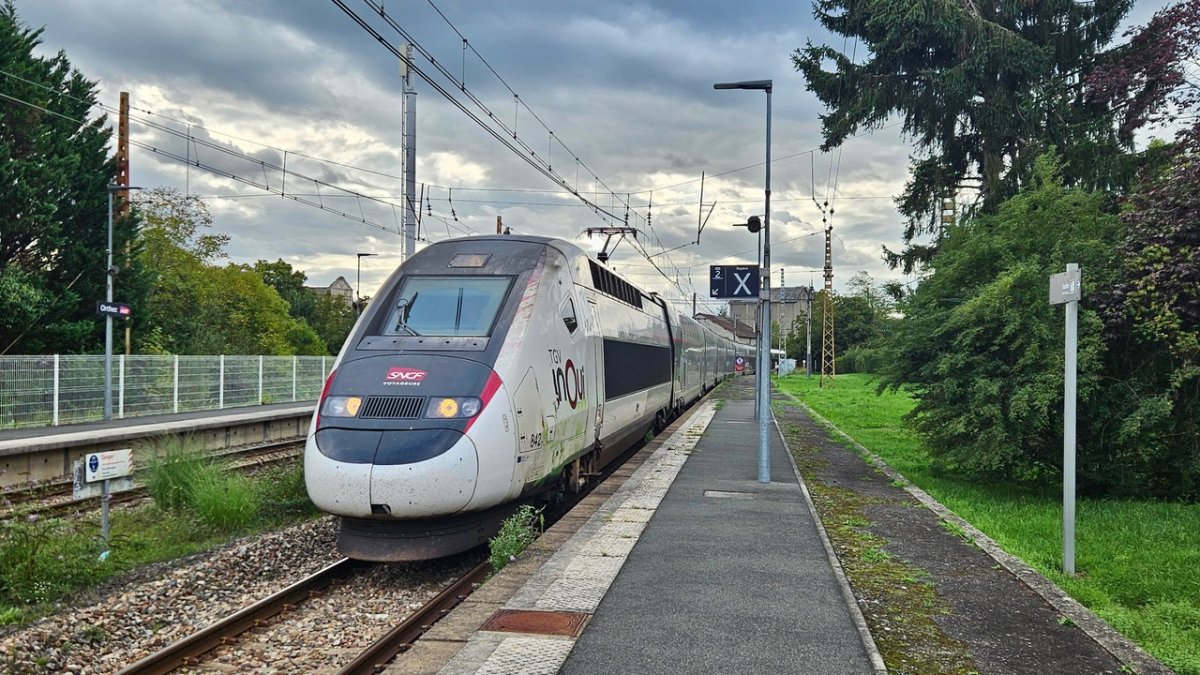
Not quite in the champs de betteraves, Orthez in Pyrénées-Atlantique département (population 11,000) is typical of the smaller towns blessed with TGV service thanks to regional policy. Two of the four daily Paris – Tarbes TGVs stop here, journey time from Paris around 4h, as does the night train. Under heavy skies on 9 September 2025, Euroduplex 842 draws into Orthez at 18.03 with TGV 8575 14.05 Paris – Tarbes.
Bussereau plans ‘solidarity’ between operators
Roughly half the 180 TGV destinations are links between Paris and large cities, generally regarded as profitable. The rest serve stations in small and medium-sized towns or are inter-regional services that bypass Paris. These presumed loss-makers play an essential role in disenclavement (opening up) of rural and disadvantaged areas. Nevertheless, the report notes that all TGV services are profitable for SNCF as a whole even though individual services may be unprofitable for SNCF Voyageurs.
They include the so-called champs de betteraves stations (‘in the beetroot fields’, ie in the middle of nowhere) like Haute-Picardie, services extending well beyond the LGV network such as to Brest, Quimper and Tarbes, and stops at smaller towns en route. These links are cross-subsidised by SNCF Voyageurs, profitable lines compensating for deficit services to the tune of €200 million per year, with subventions from the régions to support service in some cases (Bretagne and Hauts-de-France, see item below). New entrants naturally target the most profitable routes and stations; they do not feel constrained to provide non-profitable services, maintaining that high access charges are sufficient contribution towards their cost. SNCF considers the rules of competition unequal if it must continue to serve stations where new entrants see no financial gain from stopping.
The report sets out nine recommendations beginning with a three-to-five-year transition during which current services would be maintained and assessed, prior to establishing a solidarity mechanism ‘explicit, measured, operator-neutral’, to preserve regional access without undermining market liberalisation. Measures would be implemented in stages: internal efforts by the operator, adjustment of track access charges (down €75 million annually by 2034), consideration of regional development needs during capacity allocation, adaptation of commercially operated services, and as a last resort public service contracts to maintain socially desirable services or stops at ‘fragile’ stations, for which more support might be sought from the régions. Finally, a ‘high-speed solidarity fund’ is proposed, financed by a 0.9% levy on domestic service revenue.
Where direct TGV service can no longer be justified, there would be guaranteed connections instead. The report cites Tourcoing, where average usage is eight passengers per train. Given the easy access from Tourcoing to Lille Flandres gare by metro Line 2, the reviewers consider that TGV service could be withdrawn with minimal inconvenience. Other trains might be limited to operating on certain days of the week, or at holiday times. The report warns that rolling stock strategy must take account of withdrawal by 2035 of single-deck Atlantique and Réseau trainsets more suitable for less-busy routes. High-capacity TGV Ms will not be a viable alternative.
Welcoming the report, the government said it ‘favours a balanced approach mobilising all stakeholders’ and ‘continued need for reflection on financing TGV services for regional development’. Financial incentives and ways to optimise productivity of train operators offered the best way forward, it said. Operators’ association AFRA considered the report premature. It views access charges as too high (‘the highest in Europe’); ‘there is no urgency’ it said, suggesting that 2030 would be the time to take action if necessary.
Hauts-de-France reacted to a perceived threat to its TERGV services (TER Grand Vitesse) which since 2000 have offered unreserved local travel on Paris bound TGVs between Calais, Boulogne, Étaples, Rang-du-Fliers and Lille. Used by 2.5 million passengers annually, the trains are supported to the tune of €39 million (2025) under an agreement that runs until 2028. HdF president Xavier Bertrand wrote to SNCF PDG Jean Castex on 12 August seeking assurance that the services would be maintained and that no TGVs working them be withdrawn or transferred to other areas. He also sought a reduction in the €10 million annual access charges paid by the région.
SNCF’s bumper first half
With additional fees from a 1% increase in the number of trains run, SNCF Réseau’s turnover rose 3.2%, helping the Groupe commit to a record €4.9 billion investment in new rolling stock and infrastructure work. On the freight side, Rail Logistics Europe (including Hexafret) turnover increased by 3.9% to €948 million; profit rose 0.5 percentage point to €118 million. The Geodis logistics business saw revenue decline 1.8% due to geopolitical factors, while at urban transport operator Keolis income was up 5.2% to €3.7 billion.
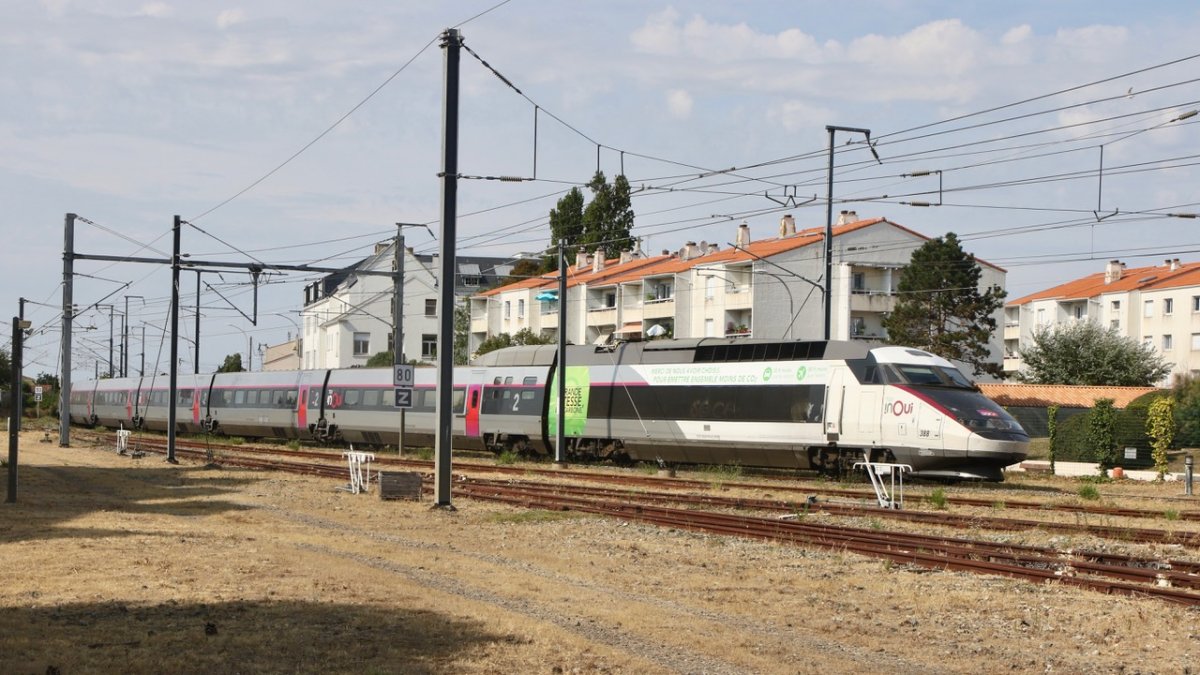
Above. On Sunday 2 August TGV Atlantique set 388 arrives at Les Sables-d'Olonne station with TGV 8977 13.31 from Paris-Montparnasse. The roof sections over the driver's cabs have been painted white to reflect the sun and reduce solar gain. Photo: Georges Turpin.
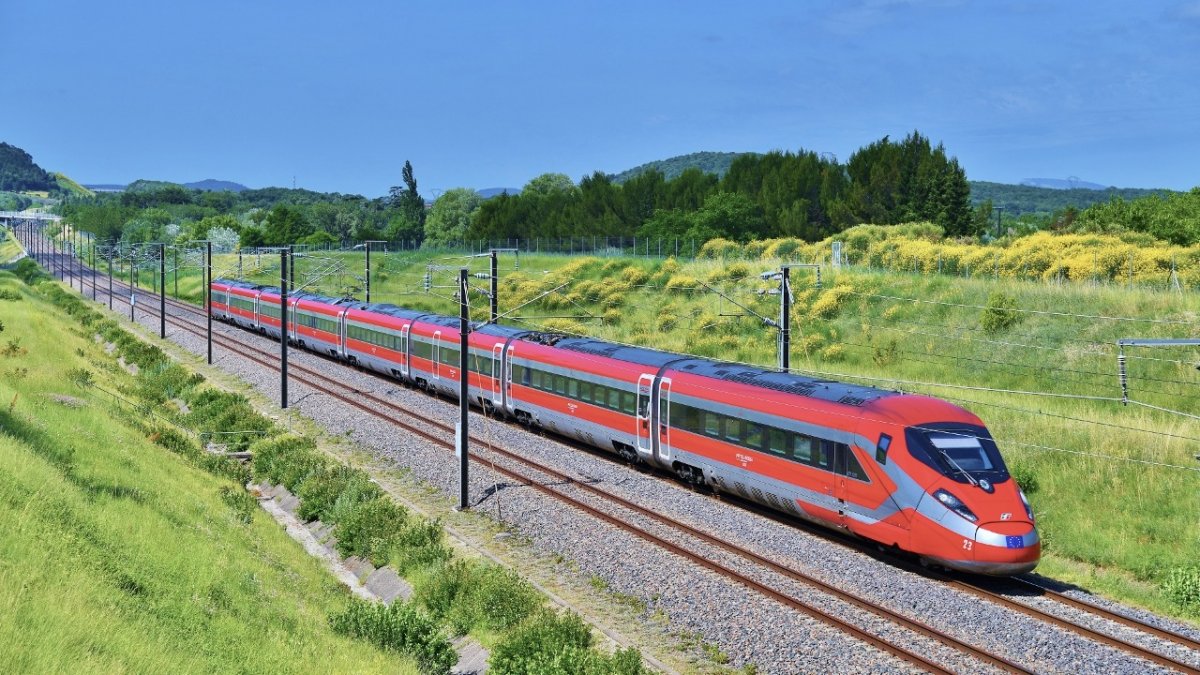
Frecciarossa set 22 heads up the TGV Méditerranée at Montboucher-sur-Jabron between Avignon and Valence on 9 June with 6104 Marseille -St Charles – Paris-Gare-de-Lyon. Photo: Pierre Julien.
Trenitalia orders Paris – London trains
“This order represents a strategic milestone for FS Group: it strengthens our presence in France, a key market for our international growth, and supports the development of increasingly efficient, sustainable and competitive high-speed services,” said Gianpiero Strisciuglio, CEO of Trenitalia’s parent company FS, when the order was announced on 7 August. The trains will offer high standards of comfort, innovation and sustainability; next-generation wifi, a new bistro concept, enhanced catering, and redesigned interiors to provide an even more comfortable travel experience in all classes of accommodation. Trenitalia currently offers four classes on its French trains and its premium Frecciarossa Mille services in Italy.
Valued at roundly €2 billion, the contract includes long-term maintenance and technical support which Hitachi will provide at Trenitalia’s depot under construction at Maisons-Alfort Pompadour in southeast Paris. Observers have pointed out that this site, ideal for Gare de Lyon and LGV Sud-Est, is not well-placed for trains to the Channel Tunnel, requiring lengthy empty running to reach Gare du Nord. It was also noted that in announcing the 2029 start date for Paris – London services, no mention was made of the regulatory, security, certification and track access issues involved. Modern Railways reported an ORR spokesperson as saying on 13 August: “we have no application for HS1 access from Trenitalia”. The order will be financed through Trenitalia’s partnership with US fund Certares, under which the latter will now take a minority stake in Trenitalia France.
October 2030 date for Virgin
Virgin has 12 Avelia Stream trainsets on order from Alstom for these services. Several hurdles remain: it must secure access rights to the Channel Tunnel and the French rail network, as well as obtaining safety approvals from authorities on both sides of the Channel. Virgin was granted access to the Temple Mills maintenance depot in east London last year, but presumably an arrangement will have to be made for overnight berthing and light maintenance in the Paris area.
Eurostar appeals. Criticising the ORR decision, Eurostar described the capacity allocation process as ‘secretive and unfair’; it has lodged an appeal. According to The Times, Eurostar ‘didn’t even know there was a process [under way]…when we were invited to participate, the deadlines…were completely unreasonable’. The appeal also accuses HS1 of ‘unlawfully reserving capacity’ for Virgin over other operators, giving Virgin ‘discriminatory special status’. A Eurostar spokesperson told The Times “I understand this seems defensive, but it’s not. It’s about trying to maximise the opportunity for everyone to invest”.
Eurostar repeated its warning of last year that ‘premature’ granting of access rights to other operators, eroding its monopoly, could jeopardise its investment and expansion plans, including purchase of 30 Alstom Celestia double-deck trains. Squeezing more trains and passengers into the existing facilities at London St Pancras International ‘could undermine safety’, it said. Regarding the restricted capacity at St Pancras, ORR said, ‘an increase in services…will demand more robust operational working’, but this ‘relies on sound operational management’ and it does not consider that this should preclude introduction of Virgin Trains services.
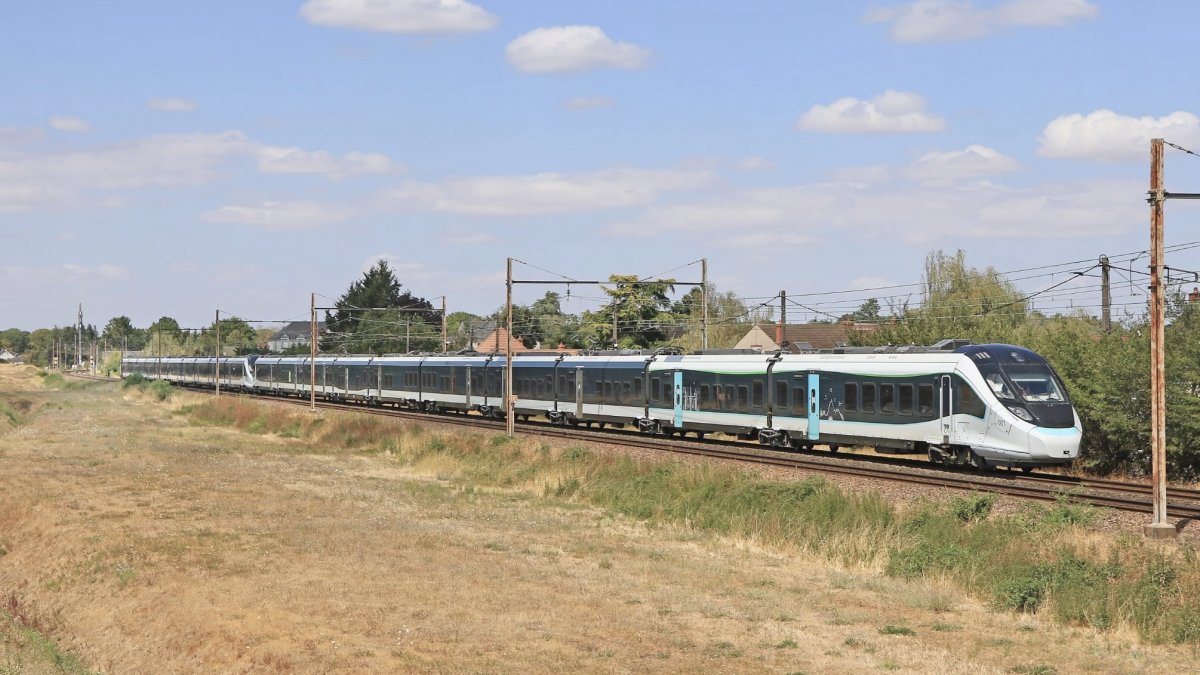
During August the two pre-production Oxygène sets PS1 and PS2 (Z26701/02 and Z26703/04) were undergoing multiple unit testing at 200km/h along the Sologne straight between Les Aubrais and Vierzon. They are seen above on 9 August at Saint-Jean-le-Blanc, in the suburbs of Orléans, setting off towards Vierzon. Only the first two cars of the leading unit feature the final livery, complete with coloured doors, a green pinstripe, and sketches of the towns along the Paris –Toulouse and Paris – Clermont-Ferrand lines that the trains will serve. Photo: Christophe Masse.
Countdown to GPE opening
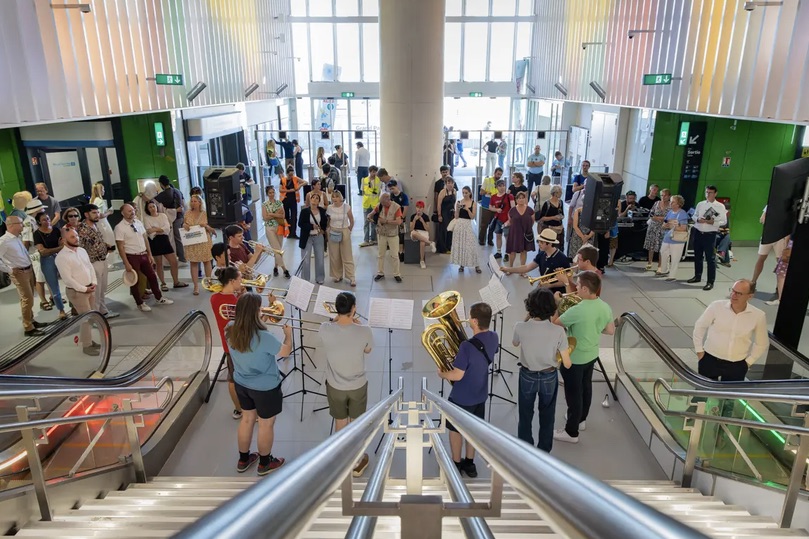
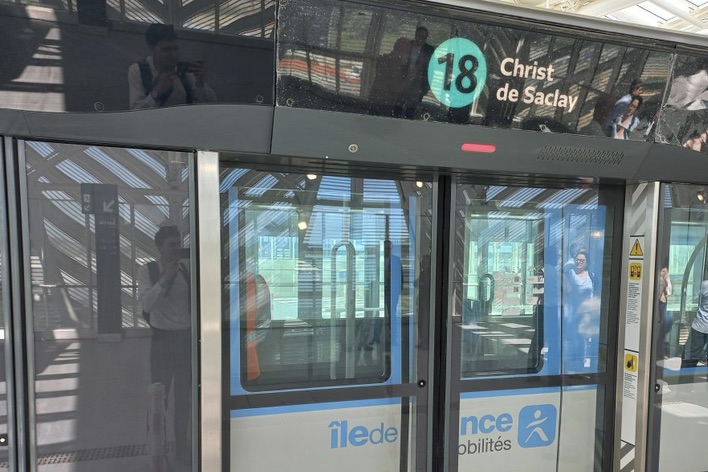
While the four stations are complete, several steps remain before public service can start. Trial running with multiple trains has been underway over the summer, and staff from operator Keolis and maintenance teams from RATP-Infra are undergoing training on the equipment and procedures prior to technical handover of the line on 30 September. This will be followed by a two-month full-scale dress rehearsal before opening day. This test phase, managed by Keolis in collaboration with Société des Grands Projets, involves running trains under real operating conditions (without passengers) to test the entire system and familiarise staff.
Ten of the 15 three-car trains ordered from Alstom are on site, with the remainder scheduled for delivery before opening day. Trains will run every 5min in the peaks and 10min off-peak. They take 1.5 kV DC power from a third rail (unlike the other lines which are 1.5kV overhead) and are equipped for GoA4 unattended automated operation at up to 100 km/h. Ridership is estimated at 118,000 passengers a day.
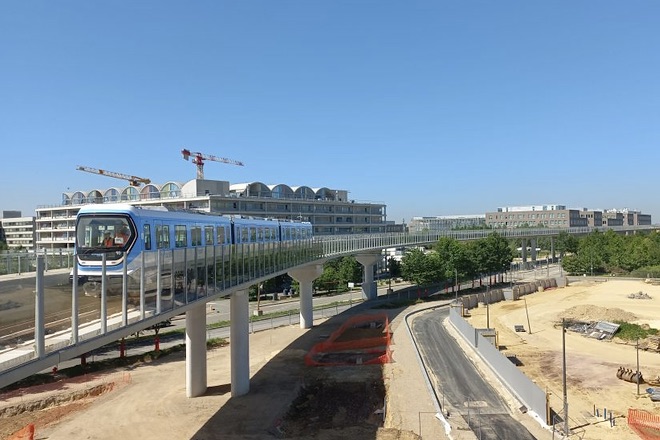
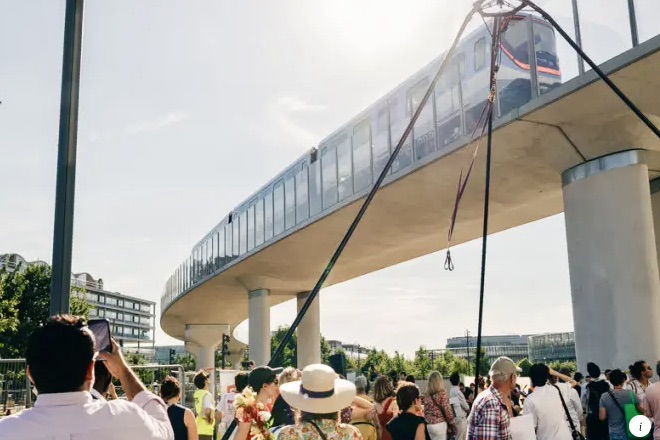
The second stage from Massy-Palaiseau east to Aéroport d’Orly connecting with Line 14 will open by the end of 2027, with the third phase running northwest from Christ de Saclay to Versailles-Chantiers expected in 2030. Tunnelling of the third phase was completed on 15 July when boring machine Awa broke through at Stade de Versailles, having dug the 6.8km from Guyancourt.
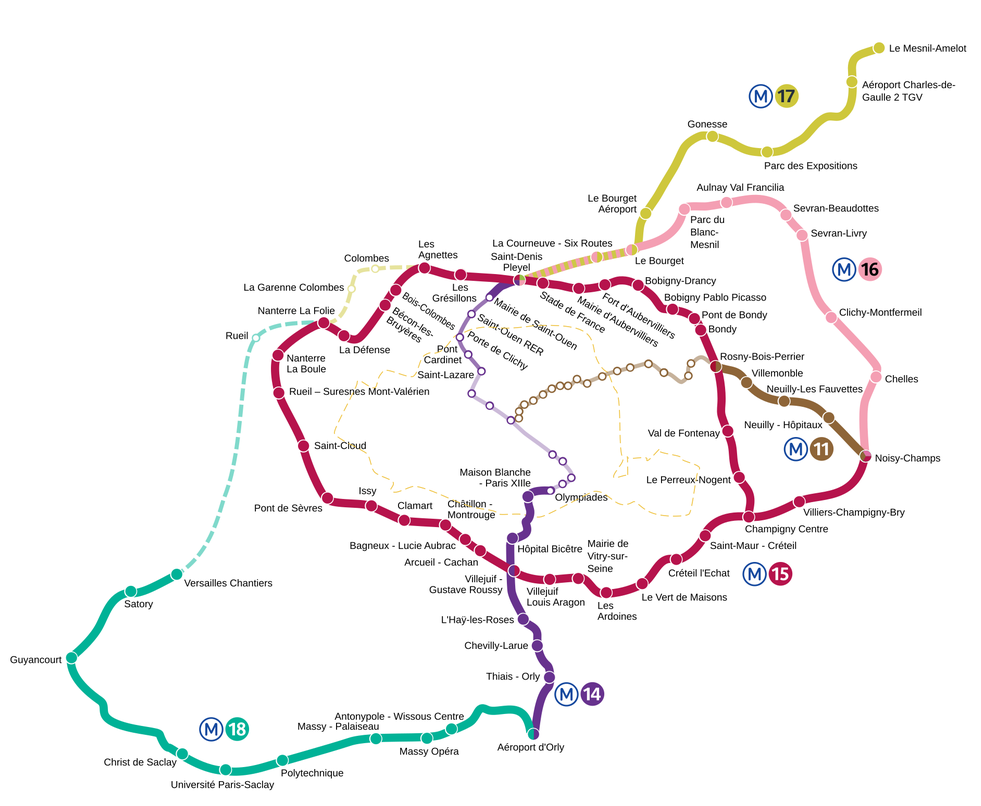
Though the north and south extensions of Line 14 opened in 2024 have been considered part of the GPE project, this is the first portion to open of the grand scheme for orbital routes developed from RATP’s 2005 master plan. Preliminary work started in 2012, civil engineering in 2016 and tunnelling in 2018. The four lines 15, 16, 17 and 18 extend to 162 route-km, mostly underground, with 68 stations. Photos: Société des Grands Projets.
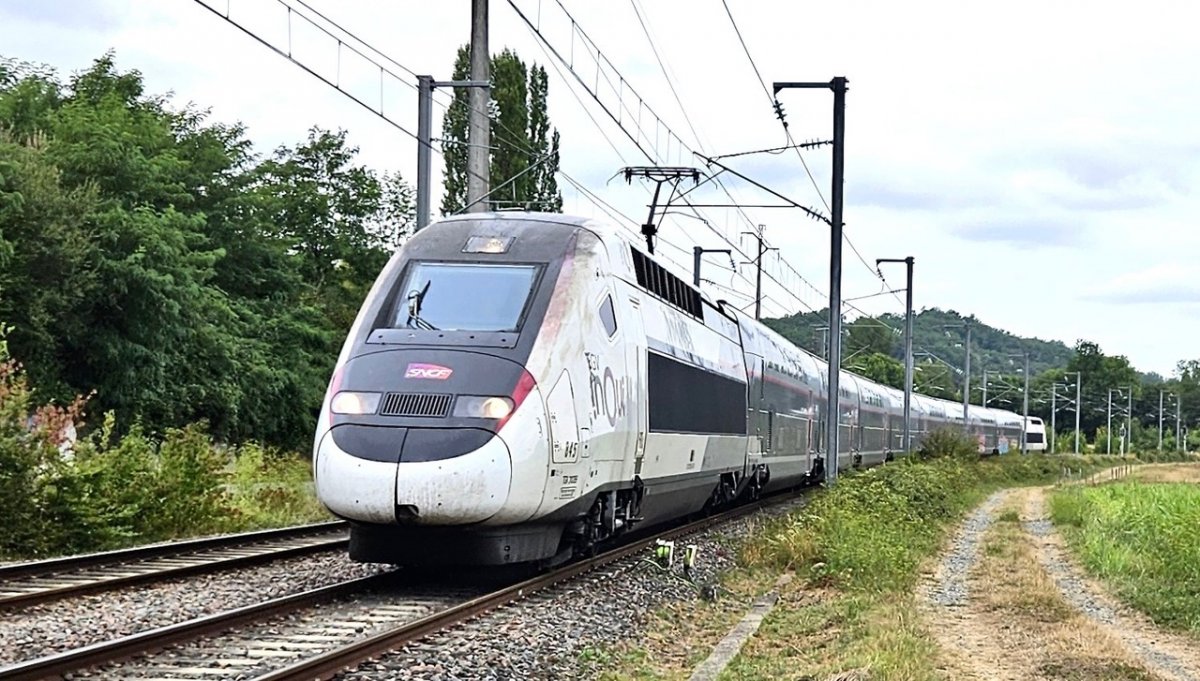
After 41.5deg recorded at Tournay on 29 July, it was a comfortable 21 on the morning of 1 August. At 11.17 Euroduplex Set 845 is seen at the foot of Capvern bank with the delayed 10.22 Tarbes – Paris via Toulouse.
Spared by the fires
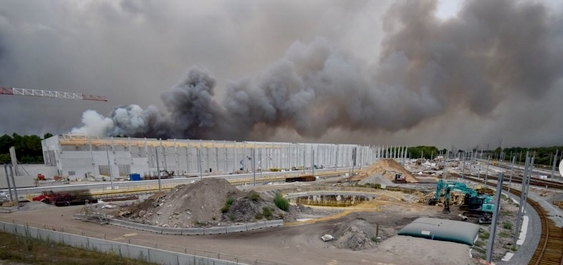
Trains south of Bordeaux resumed on 1 August, sooner than had been expected after SNCF Réseau found ‘no major degradation’ of the infrastructure caused by wildfires that raged across Gironde and Landes in the last 10 days of July. The préfets of the two départements authorised inspection trains on 31 July and their work was completed within 24h. Staff found minor signalling and power supply problems (such as discharge of back-up batteries), and some tracks were washed to remove ash, but nothing to prevent reopening of the Arcachon line and resumption of service between Bordeaux and Morcenx/Mont-de-Marsan. With the fires ‘coming under control’, evacuated residents were allowed home.
Residents of Marcheprime in Gironde were able to return to their homes on 1 August. Some found their properties destroyed as the fires menaced the town from the west. The railway was undamaged, as was the construction site of Lisea’s SMR high-speed train maintenance depot 3km northeast where work stopped until safety clearance was given. Lisea made its firefighting equipment and resources available to assist the collective effort, expressed solidarity with townspeople and thanked all who had worked to prevent the fires spreading. Photo taken at 17.50 on 26 July: © Lisea timelapse GO.
About 50% of TGVs ran south of Bordeaux on 1 August, with a full service the following day. Before the main line reopened, SNCF’s plans for the busy holiday changeover weekend saw Paris-bound TGVs running from Tarbes to Bordeaux via Toulouse with delayed departure awaiting passengers from Lourdes and Pau arriving by TER. Though shown as non-stop to Bordeaux, these trains were usually coupled to a regular Paris service at Toulouse, further increasing the journey time.
On 1 August, Paris TGVs were arriving from the west (ie their usual route) but departing eastwards. TGVs 8580/8582 from Tarbes at 10.28 and 12.22 both ran via Toulouse; TGV 8584 at 16.19 to Paris was cancelled, as was 8575 13.59 from Paris, and ICN 3740 20.32 Tarbes – Paris also ran via Toulouse. On 2 August, several extras ran to clear the large number of returning holidaymakers. Free-of-charge ticket exchange or reimbursement was extended until 4 August.
During the last week of August the weather turned with a vengeance. Due to the risk of violent storms TER services between Toulouse and Auch were cancelled on Monday 24, with major delays between Toulouse and Bayonne. The tornado that swept through the town of Pomas also damaged the Carcassonne - Limoux line with trains suspended for some days.
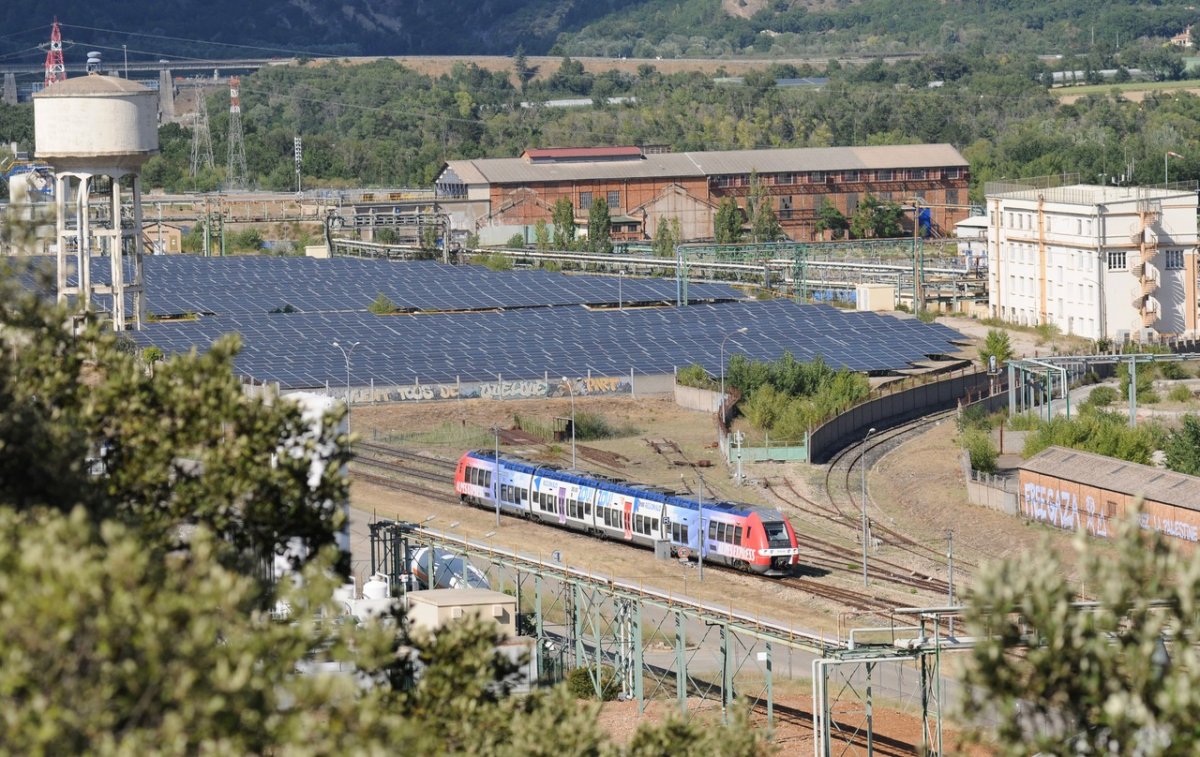
On 7 August TER 17439 12.44 Briançon – Marseille is 38min late arriving at Château-Arnoux-Saint-Auban past the junction of the line to Digne heading off to the right. B 81605/06 carries the Alpes Express vinyls applied this summer to promote the 2030 Winter Olympics. The solar farm built on brownfield land opened in 2024 to supply the Arkema plant and other local power needs. Photo: Philippe Leynaud.
Digne reopening ‘not a priority’
Reopening the line to Digne-les-Bains has been rejected by SNCF as ‘incompatible’ with the Sud-Alpes modernisation. Though the line did not figure in the plans, during public consultations on the project elected officials, several towns, Fnaut and Alpes-de-Haute-Provence département restated their support for reopening to fill ‘a critical gap’ in the 2030 Winter Olympics transport plan. Responding, SNCF said the Digne line did not form part of the upgrade and that ‘the socio-economic balance of reopening had not been demonstrated’. Reopening would ‘impose significant deadlines’ and possibly imperil the entire project.
The 22km Digne line is the ‘missing link’ in the Sud-Alpes network according to proponents; the town of 17,000 is prefecture of Alpes-de-Haute-Provence. Passenger service to Digne from Château-Arnoux-Saint-Aubin on the Marseille – Veynes – Briançon line was withdrawn in 1989, cutting rail access to the resort and leaving the CF de Provence metre-gauge route to Nice as the only link (and itself closed to Digne for the past several years). Reopening has widespread support, including from Sud PACA, but the région is unwilling to risk diversion of funds from the Sud-Alpes upgrade. Last December, the région’s president said: ‘SNCF Réseau estimates the cost [of restoration] at between €87 million and €160 million, which compels me to prioritise the Alpine line’.
Fnaut rejected the estimates, pointing out that recent reopenings have cost €0.6 to €2 million/km. ‘A missed opportunity’ it said, to encourage modal shift, ease car commuting between Digne and towns on the Aix – Veynes line, improve tourist access to the CP line, and contribute to the financial wellbeing of the Sud-Alpes network. Opponents cite safety considerations around the Arkema chemicals plant adjacent to the line at Château-Arnoux making reopening problematic, as well as breach of the formation in several places, one of which would require a deviation. Their preferred use for the alignment is a voie verte.
Train des Plages off, then on, then what?
The scenario hinted at in last month’s News came to pass sooner than expected. The Train des Plages was withdrawn from 14 August after the previous day’s TER 859087 08.50 Saumur – Les Sables-d’Olonne took 5h to reach its destination due to heat-related defects in the track. Thereafter a 40km/h speed restriction was introduced between Thouars and Chantonnay. The train did not run from Saumur again, being cut back to Bressuire. A track-geometry survey on 20 August identified defects requiring urgent attention. ‘The scope of the work is significant’ SNCF Réseau said, with a start scheduled for the last week of August. It was not known if this would affect the winter service beginning on 31 August, though the intention was ‘to resume normal working as soon as poossible’.
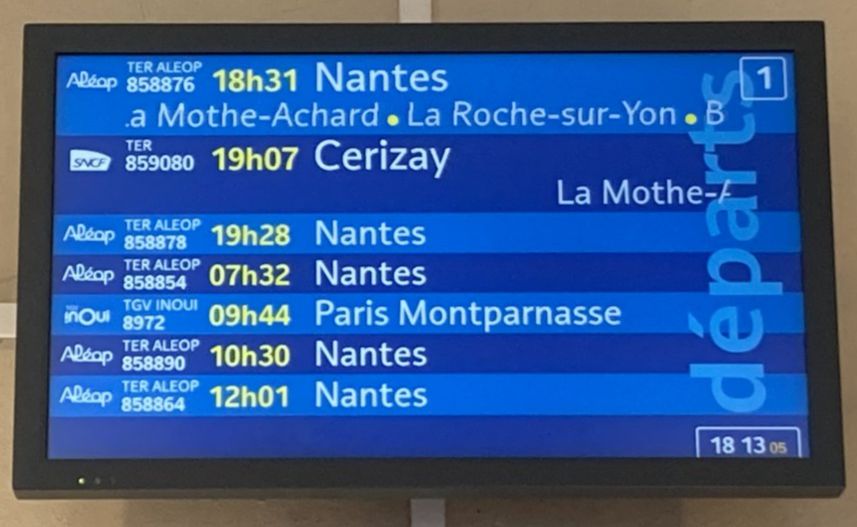
From 17 August a bus service was advertised from Saumur (depart 09.20) to Bressuire where passengers transferred to retimed TER 859087 at 11.05 for the remainder of their journey. The reason for this arrangement was not clear as other TERs were running from Saumur to Bressuire. The return train left Les Sables as usual, arriving Bressuire at 21.30 with bus thence to Saumur arriving 23.10. On certain days, the returning train was terminated at Cerizay, running ECS to Thouars after dropping its passengers.
Opposite. The departure board at Les Sables, possibly the first time a train has terminated at Cerizay. Photo: Georges Turpin.
Finding sufficient replacement buses was problematic in the holiday season, complicated by the need to accommodate beach paraphernalia such as cool boxes, folding chairs, umbrellas and inflatables. Other services were also affected by the heat. Bressuire’s one or two daily to Saumur, normally a pair of X 73500 autorails, were replaced by buses on more than 20 occasions in July and August due to ‘non-availability of air-conditioned stock’ (ie failure of refrigeration units on the railcars).
Infrastructure upgrading to keep the line open is costed at €128 million, of which only €10.9 million has been made available by Pays de la Loire and Nouvelle-Aquitaine. The balance is beyond the resources of the two régions even if such expenditure was considered desirable for this lightly-used line.
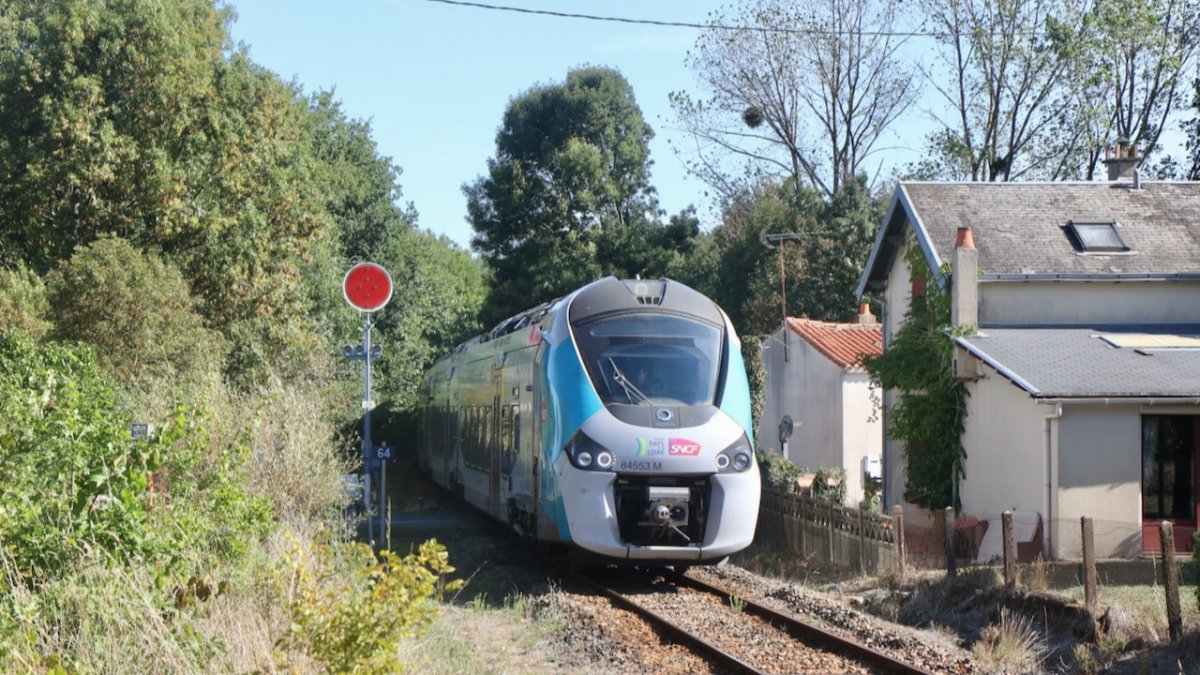
Above. Things worked better last summer! On 24 August 2025 Train des Plages TER 859081 Saumur – Les Sables d’Olonne is seen passing the mechanical signal protecting the station at Chantonnay, Régiolis B 84553 M leading a second set. Photo: Georges Turpin.
Infrastructure upgrading to keep the line open is costed at €128 million, of which only €10.9 million has been made available by Pays de la Loire and Nouvelle-Aquitaine. The balance is beyond the resources of the two régions even if such expenditure was considered desirable for this lightly-used line.
Above. Things worked better last summer! On 24 August 2025 Train des Plages TER 859081 Saumur – Les Sables d’Olonne is seen passing the mechanical signal protecting the station at Chantonnay, Régiolis B 84553 M leading a second set. Photo: Georges Turpin.
Breton improvements deferred
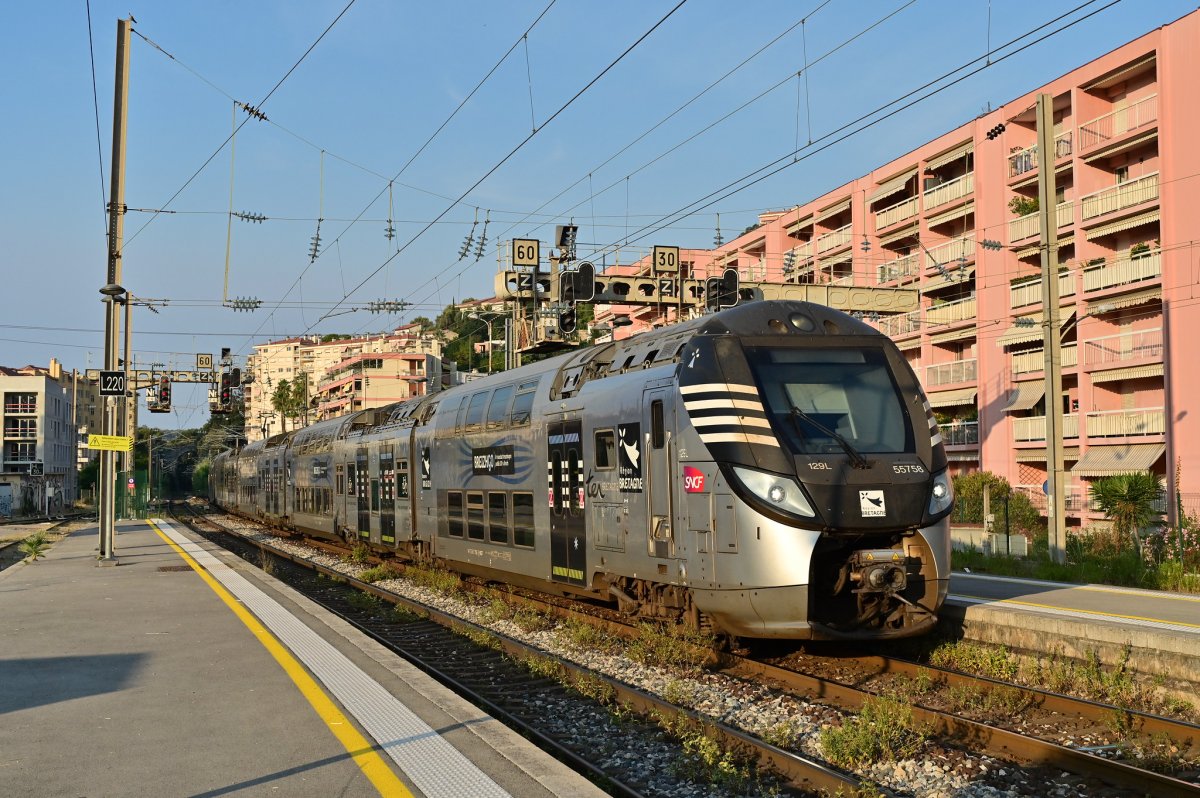
Service improvements in Bretagne that were to have been implemented from 31 August have been deferred for a year. Despite delivery over the summer of nine Régio 2N EMUs, the région says budget cuts and a €40 million drop in State funding prevent it from introducing the nine additional services planned for Bretagne Nord lines, as well as the four scheduled for Bretagne Sud. Instead, the new trains are being used to augment the most overcrowded services, a plan that has enabled short-term lease of two Régio 2N sets to Région Sud PACA.
Passengers’ groups had noted summer cancellation of 25 services due to rolling stock shortage and 24 attributed to breakdowns, as well as observing BreizhGo-liveried trains running on the Côte d’Azur. The région said that most cancellations were of diesel trains which could not be replaced by EMUs. ‘This one-year rental, from the beginning of August, will generate revenue to finance rail improvements and reduce maintenance costs of equipment that, even if not used, requires servicing. Renting trains between regions is a common occurrence’. All nine new Régio 2N sets were scheduled to be in service in Bretagne by mid-September.
Above. TER Bretagne BreizhGo liveried Régio 2N Z 55757-55758 is along way from home at Menton on the 19 July with the 06.37 Nice-Ville – Vintimille. Photo: © Gwenaël Piérart
News in Brief
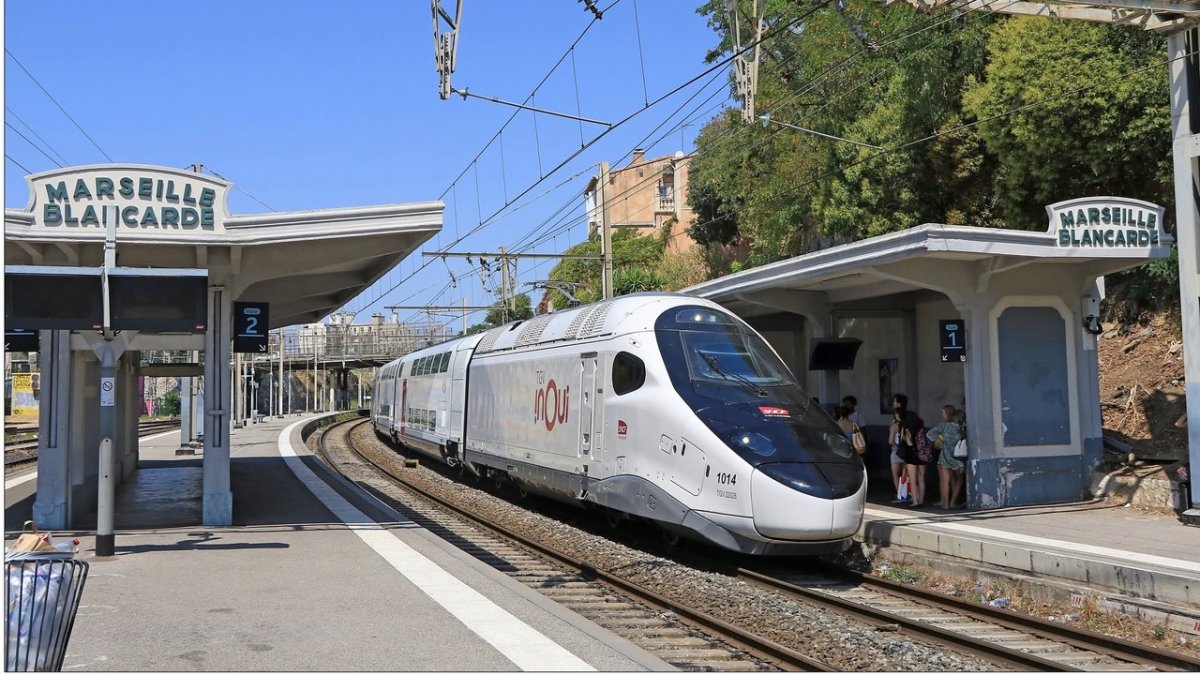
TGV M made its first advertised commercial run on 13 August, sets 1012 and 1014 forming Inoui 35091 08.26 Paris Gare de Lyon – Marseille. Delayed preparation of the train led to a 20min late departure and arrival at Marseille Saint-Charles was 30min down at 12.29. The new trains had operated this dated service several times in July and August with SNCF and Alstom staff as volunteer passengers, but this was the first public run. The train is seen after arrival at Marseille Saint-Charles passing through Marseille Blancarde, en route to the depot at Toulon. Official inauguration of the long-awaited new trains is planned for early September. Photo: Christophe Masse.
Battery MUs. Having received safety certification in April, the five lithium-ion battery-powered AGC MUs converted at a cost of €40 million, are entering commercial service. The first, Région Sud PACA’s B 81603/04 BE, has been running on the Avignon – Carpentras line and then will move to Marseille – Miramas via the Côte Bleue. Nouvelle-Aquitaine’s B 82775/76 BE will run this autumn on the Bordeaux – Mont-de-Marsan/Saint-Mariens/Le Verdon lines, while Occitanie’s B 83519/20 BE will run initially between Nîmes and Vauvert on the line to Le Grau-de-Roi.
Colmar – Freiburg shelved. Germany has abandoned the Colmar – Freiburg reopening just weeks after committing to fund its share of the €880 million cost (see August News). France’s view of the project as unviable given its poor cost/benefit ratio seems to have swayed local officials, along with reticence at a time of economic crisis. Baden-Württemberg’s transport minister announced ‘suspension’ of the pared-down scheme on 17 August. Paradoxically, French supporters of reopening see the decision as an opportunity. Pressure group Trans Rhin Rail says it will now urge Grand Est région to restart passenger service on the 19km Colmar – Vogelsheim freight line as a testbed for light railcar technology such as Ecotrain. Having received ERA clearance,
Having received ERA clearance, Eurostar ran an E300 trainset under ERTMS for the first time on 17 July. Eight sets are being equipped to meet Belgium’s requirement for all trains to be ETCS-fitted by the end of 2027. The work is being carried out by Masteris at SNCB’s Namurworkshops with input from SNCF Voyageurs Matériel. The remaining seven sets will now be equipped, completing installation of ERTMS/ETCS across Eurostar’s entire fleet.
Collioure. With 100,000 visitors arriving for the town’s fêtes de Saint-Vincent fireworks on 16 August, 20 specials ran during the afternoon, hourly from Narbonne and Perpignan (half-hourly after 17.14), and half-hourly from Cerbère. A similar service ran after the show, with last trains leaving for Cerbère at 01.11 and Narbonne at 01.13. The widespread ban on fireworks during the hot weather did not apply to shows over water. For the braderie at Lille on 5-6 September, 54 extras were planned by Hauts-de-France with 15,000 tickets from €3 to €22.
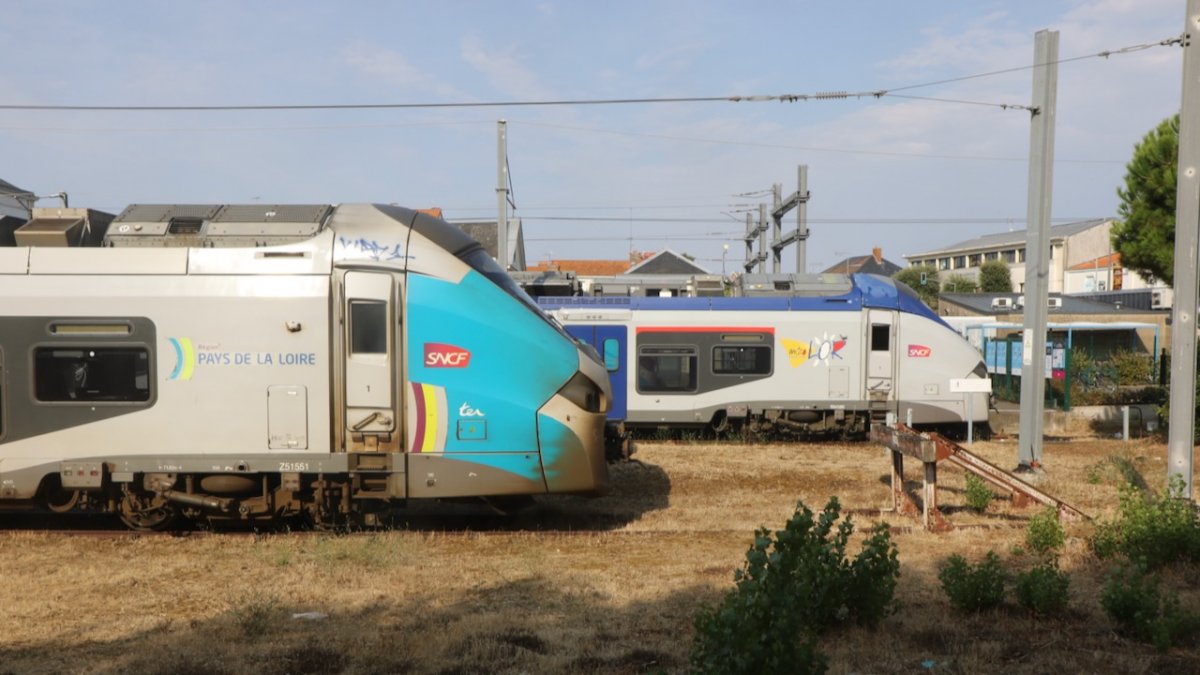
During the summer Pays de la Loire TER has leased stock from Grand Est with B 84589 seen at Les Sables-d'Olonne on 15 August. Photo: Georges Turpin.
The council at Morcenx-la-Nouvelle has approved purchase from SNCF Réseau of 0.4Ha of land around the station for construction of the long-proposed multimodal interchange now due to start later this year. The €3 million project includes parking for 500 cars.
Caley Beds to Paris? A Transport Scotland working group met on 4 August to launch a feasibility study into possible Caledonian Sleeper service ‘to mainland Europe’, where Paris would be the most likely destination. The study fulfils a commitment made by the SNP in its recent election manifesto.
RER Line D. After five weeks’ preparation, overnight work started on 10 August to replace 20km of track between Lieusaint-Moissy and Melun using two factory trains. Completion is scheduled for 7 November.
Montceau-les-Mines. Two members of the Mecateam railway cluster have open days this autumn: rolling stock maintenance specialist Erion on 21 October and 9 December and infrastructure machinery builder Novium on 28 October and 16 December. Details at:
https://www.creusotmontceautourisme.fr/dans-les-coulisses-de-lindustrie/Though the rolling stock still awaits certification, Puy de Fou has begun recruiting personnel for its Grand Tour luxury train. Positions range from train manager through hotel and catering staff to performing artistes. The company is also seeking an operating licence.
Granville. Increasing concern about the future of the line to Paris, said to be ‘at imminent risk of closure’ due to the state of its infrastructure, led the president of Normandie région and more than 50 elected officials to write to the prime minister. The 328km link is the only main line out of Paris to be classified as a desserte fine. With the line requiring up €1 billion for maintenance and renewals over the next 15 years, Normandie has said that it cannot finance its share of the work and seeks to have the line reincorporated into the national ‘structural’ network. Opening to competition has been studied but there was no interest from potential operators in taking on the line in its unmodernised state.
Laluque. Communauté de communes du Pays Tarusate is to buy 6.6Ha of land for development of a business park and road-rail ‘dry port’ at Laluque north of Dax. The two plots are adjacent to the 12.6km Laluque – Tartas freight line owned by Nouvelle-Aquitaine région; each will have rail access. The plan envisages existing sidings at Laluque, which can accommodate 750m-long trains, serving as an overflow to Bayonne’s congested yard at Mouguerre. Industries would be attracted to a site well-placed for markets on both sides of the border with Spain. Use of the Tartas branch, reopened in 2025 after renovation costing €16.6 million, has not taken off as quickly as had been hoped, with Maïsadour grain shipments the only traffic so far.
Alès – Bessèges. Public consultation on Phase 1 of Occitanie région’s reopening proposals concluded on 4 August. There were 557 contributions of which 459 were in favour of the initial stage between Alès and Saint-Ambroix (see June News), cost €40 million. The préfète of Gard département will give her verdict in the autumn.
Alstom has signed a memorandum of understanding with Graphene Manufacturing Group for testing and development of graphene products for the rail industry, particularly in heating, ventilation and aircon systems. Graphene is a carbon with exceptionally high tensile strength, electrical conductivity and transparency. It is the thinnest known two-dimensional material.
Working overnight between 29 June and 3 October, SNCF Réseau is replacing 4,000 sleepers between Andelot and Saint-Claude on the Ligne des Hirondelles at a cost of €2.5 million. This is part of the €12 million emergency spending announced by Bourgogne-Franche-Comté last October. The région is still hoping for State aid towards the estimated €80 million cost of further work required to assure the line’s future.
Service between Monaco, Menton and Vintimille is disrupted until 8 November after an empty EMU suffered a broken axle at Cap-Martin-Roquebrune on 9 July, damaging 1,200m of track. A 10km/h restriction is in force and eastbound trains at Cap-Martin-Roquebrune and Carnolès are reduced from 60 to 23 daily, with buses provided to help clear peak-hour passengers. The holiday-time disruption led to calls for resurrection of the Nice – Monaco metro proposal.
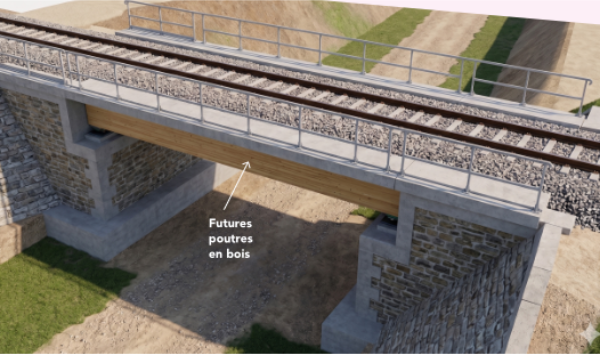
The third phase of the Tours – Chinon upgrade begins on 14 September with complete closure of the line until 26 February 2027. The 28km not rebuilt in earlier phases is being renovated at a cost of €26 million to eliminate speed restrictions, with spot track renewals, replacement of two turnouts, rehabilitation of the tunnel outside Chinon, and remedial work on seven bridges. One, at Rivarennes, uses a new technique involving timber beams topped by reinforced concrete, said to be more resistant to climate effects than traditional construction and to leave a carbon-neutral footprint. Total cost of the work since 2021 is €48.8 million financed by Région Centre-Val de Loire. Image: SNCF Réseau.
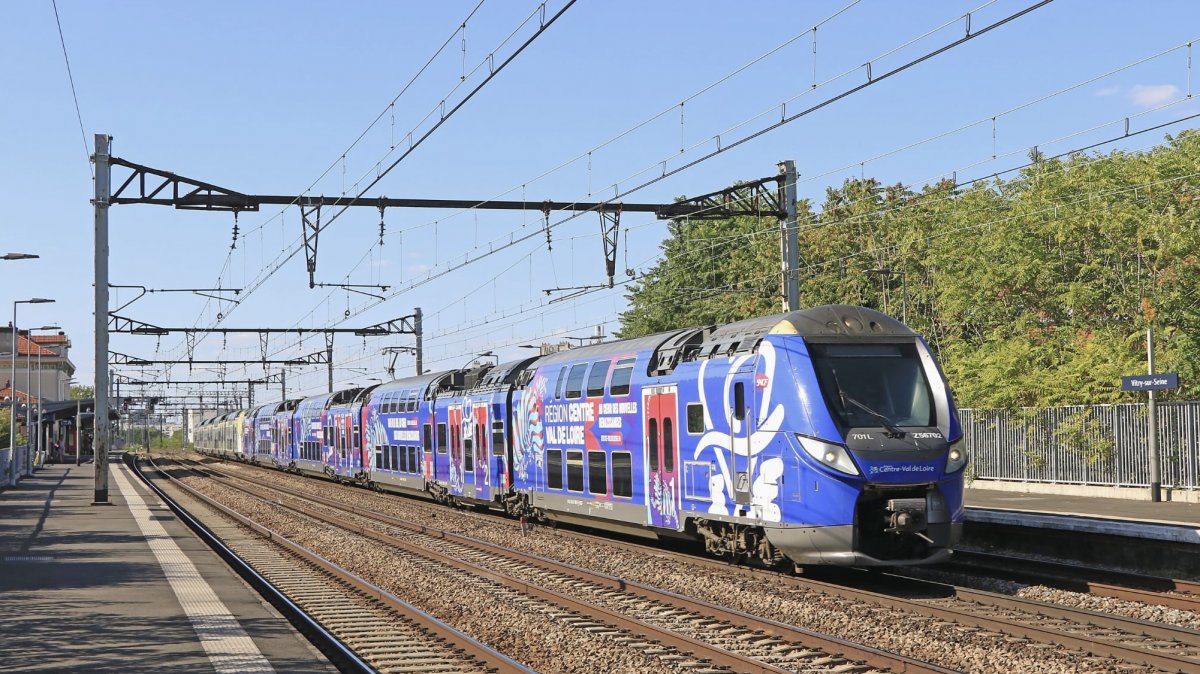
Centre-Val de Loire. The first of the région’s three TER lots is Val de Loire-Sologne-Berry for which bids will be sought in January 2027. Lot 1 comprises routes that will be part of Tours SERM: Tours – Poitiers/Chinon/Loches/Chartres, plus Tours – Orléans and Tours – Bourges – Nevers, six routes with around 10,000 daily journeys. The new operator will be announced in spring 2028 and will take over when the current SNCF operating contract ends in January 2032. The other two lots, Étoile de Chartres and Paris Express, will be tendered in 2028 and 2029.
Centre-Val de Loire TER Régio 2N set Z56701/02 has swapped its yellow for a new blue 'Nouvelles Renaissances' livery. Seen passing through Vitry-sur-Seine on 9 August with a Paris – Tours service. Photo: Christophe Masse.
Cerema looks again at rural lines
● Implications of the new transport law and its financial provisions for infrastructure maintenance.
● Scenarios for low-cost capacity improvements to provide increased frequency and thus attract more passengers.
● Financial engineering and contractual frameworks; régions as infrastructure managers; the SERM effect.
● The Nancy – Contrexéville reopening project.
● Low-cost renovation using ‘Spotlab’ collaboration techniques and shorter lifespan (good for 20 rather than 100 years).
● ‘Frugal’ signalling and control such as NS2F (see August News) and NExTRégio; innovative lightweight rolling stock; multi-purpose trains (railcars carrying light freight and parcels).
● Reuse or recycling of materials to save up to €300,000/km in renovation schemes.
● Battery MUs on order for Nice – Digne.
The meeting concluded that a combination of frugal technical solutions, innovative financial arrangements and clarified governance was the most likely way of revitalising small lines, with infrastructure and operating managers engaged to target investment accurately and offer service better adapted to users’ needs. An overview of the reports can be seen at:https://www.cerema.fr/fr/actualites/petites-lignes-ferroviaires-synthese-deuxieme-journee
Blanc-Argent. Participants heard that Centre-Val de Loire région plans to establish a co-operative to run the Blanc-Argent railway, replacing the contracted operator Keolis/Cie du Blanc-Argent once the current upgrading programme is complete. The move aims to secure the 56km metre-gauge line's future as TER services are opened to competition, foster local governance and involvement, and pave the way for service improvements.
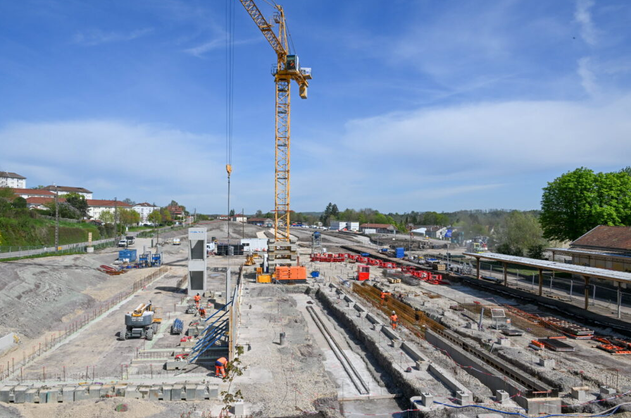
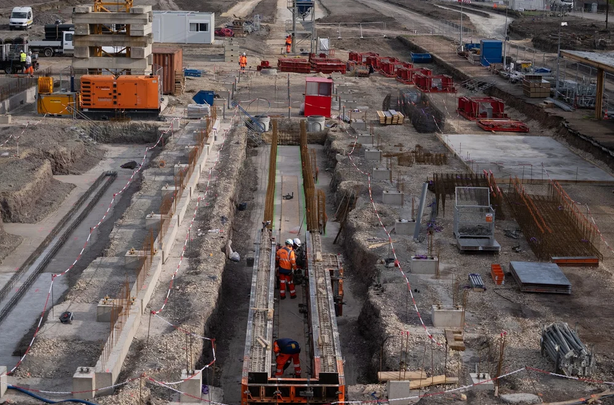
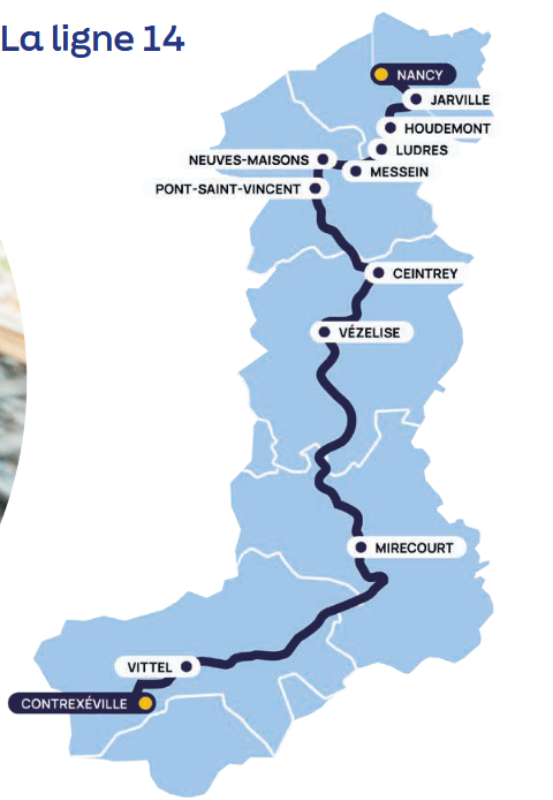
An ‘audacious’ solution. Tracklaying is scheduled to start this month on the Nancy – Contrexéville line in Grand Est being rebuilt by the Nova 14 consortium under a single concession for infrastructure management and operation, described by GE as an ‘audacious’ arrangement and a first in France. Operator Transdev is now recruiting up to 70 personnel, many of whom will be multi-skilled (eg train maintenance staff will also work on infrastructure). Before the summer holidays, foundations were laid at Mirecourt for the operations and maintenance building that will be the line’s nerve centre. GE is providing eight X 73500 autorails for the restored service due to start on 12 December 2027, amongst them X 73804/73816; they will run on B100 biofuel. Photos: Nova 14.
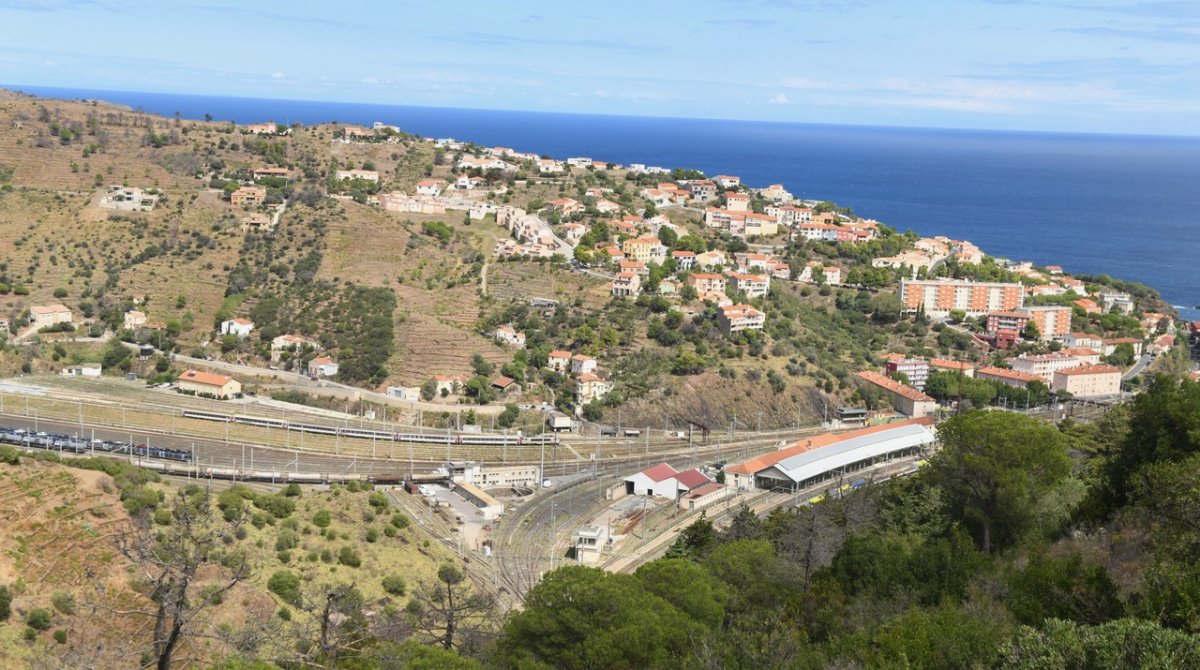
The yard at Cerbère on 1 September 2025. The standard gauge yard is virtually empty but includes the stock from the previous weekend night train from Paris. The gauge changing shed is to the left with the Iberian broad gauge curving around below the hillside on the lower left. Turn the clock back 20 years and the yard would have been full with freight having to be stabled on the seawall next to the station and the small yard at the back of the station full of locomotives.
End of an era at Cerbère
From 2021 to 2025 the number of trains handled annually fell from 976 to 206 and the number of axles swapped from 46,000 to 12,000. Two companies are reported to have expressed interest in taking over the site. From the beginning of 2027, DB Cargo’s trains between Germany, France and Spain will operate on standard gauge throughout via Perpignan – Figueres and the dual-gauge line thence to Barcelona. Initially traction will be subcontracted, but DB Cargo France intends to equip its Class 186 Traxx electric locos (186 161 to 180 and 186 301 to 345) with ETCS in 2027 and eventually deploy them through to Barcelona.
Swapping axles takes 3min per wagon, the average freight train being regauged in 2h. Through running of passenger trains was established in 1969 when variable-gauge Talgo trainsets were introduced, but the change was carried out on the Spanish side of the border at Port Bou. The last of these services, the Montpellier to Barcelona vestige of what had been the Catalan Talgo from Zürich, Geneva and Milan, was withdrawn in 2010. in 2010.
LFP Perthus. July saw ‘more than 230’ freight trains use the Perpignan – Figueres link, the second consecutive monthly record and highest number since the line opened in 2010. Operator LFP Perthus said ‘total gross tonnage and average gross weight per train reached record levels’. Access charges were reduced in January to encourage greater use of the link.
Oulchy-Breny derailment report
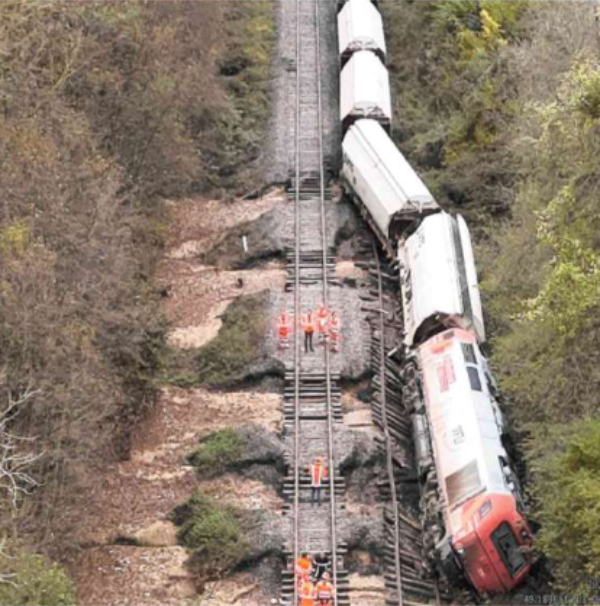
SNCF Réseau is criticised for failing to carry out inspections correctly: ‘a very serious flaw in its surveillance and security measures’ the report said. The gendarmerie had noted ‘sludge flows’ on the track but SNCF Réseau failed to follow-up with field inspection and the line was cleared for traffic though no train ran until the 30th. A contributory factor was E4047’s driver, unusually alone in the cab, who did not observe the instruction given to ‘drive on sight’ at no more than 30km/h and thus was unable to stop in time to avoid derailment.
BEA-TT recommends revision of infrastructure risk assessment factors, use of sensors to monitor ground stability, and wider application of satellite or drone technology for infrastructure monitoring. Lineside landowners should be encouraged to keep watercourses clear of debris and fallen branches and asked to alert SNCF when conditions were likely to impact safe running of trains. SNCF should consider the factors highlighted before undertaking revision of operating rules for freight trains on lightly-used lines. Photo: SNCF Réseau.
A depot for MF19
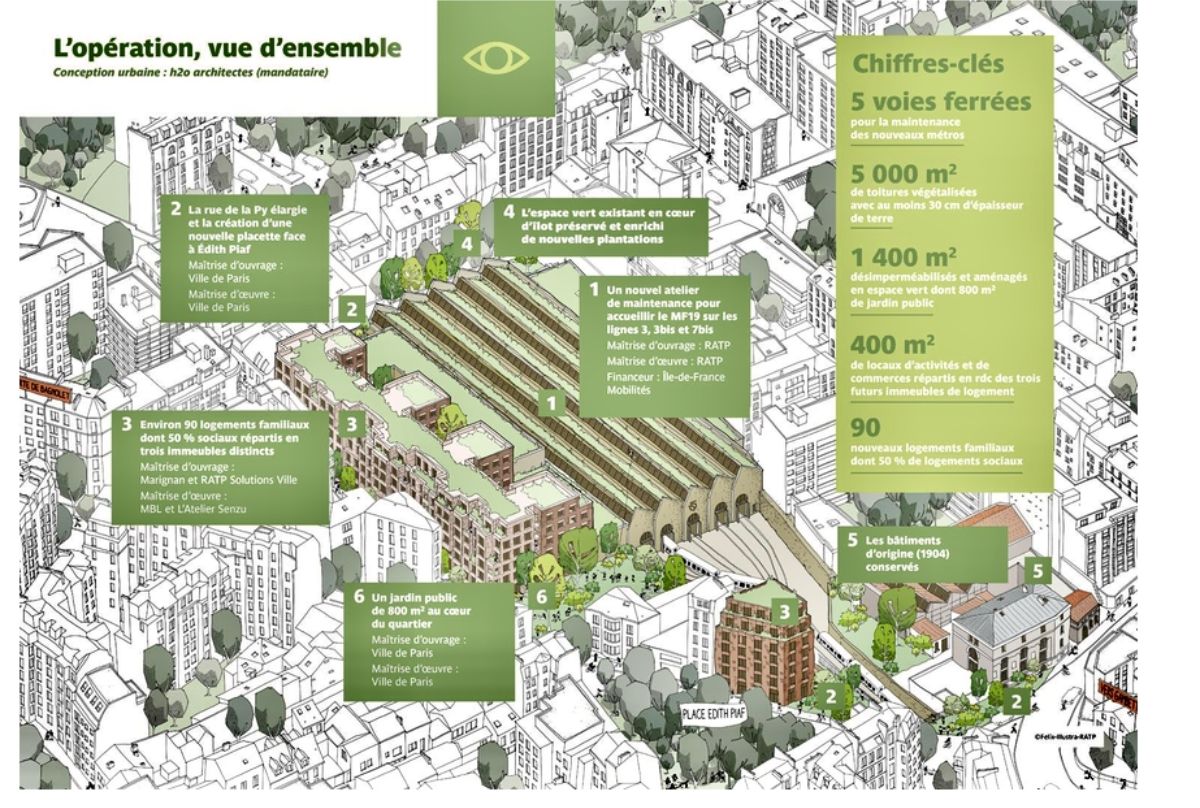
Replanning the site has seen transfer of the Equipment Maintenance Workshops (AME) of the metro, RER and tram networks to Vaugirard depot in the 15arr, freeing up 5,000m2 for MF19 use. The existing maintenance facilities with five tracks will be completely modernised and restructured, flow-management optimised and automated equipment installed. Since March, maintenance of the existing rolling stock has been transferred to three other depots including Choisy on Line 7, disrupting diagrams and creating a logistical headache for depot managers. Phased construction will reduce the nuisance to local residents and businesses. The depot will be ready in 2030 when Line 3 receives its first MF19 trains. Image: RATP/h20 architectes.
Preservation
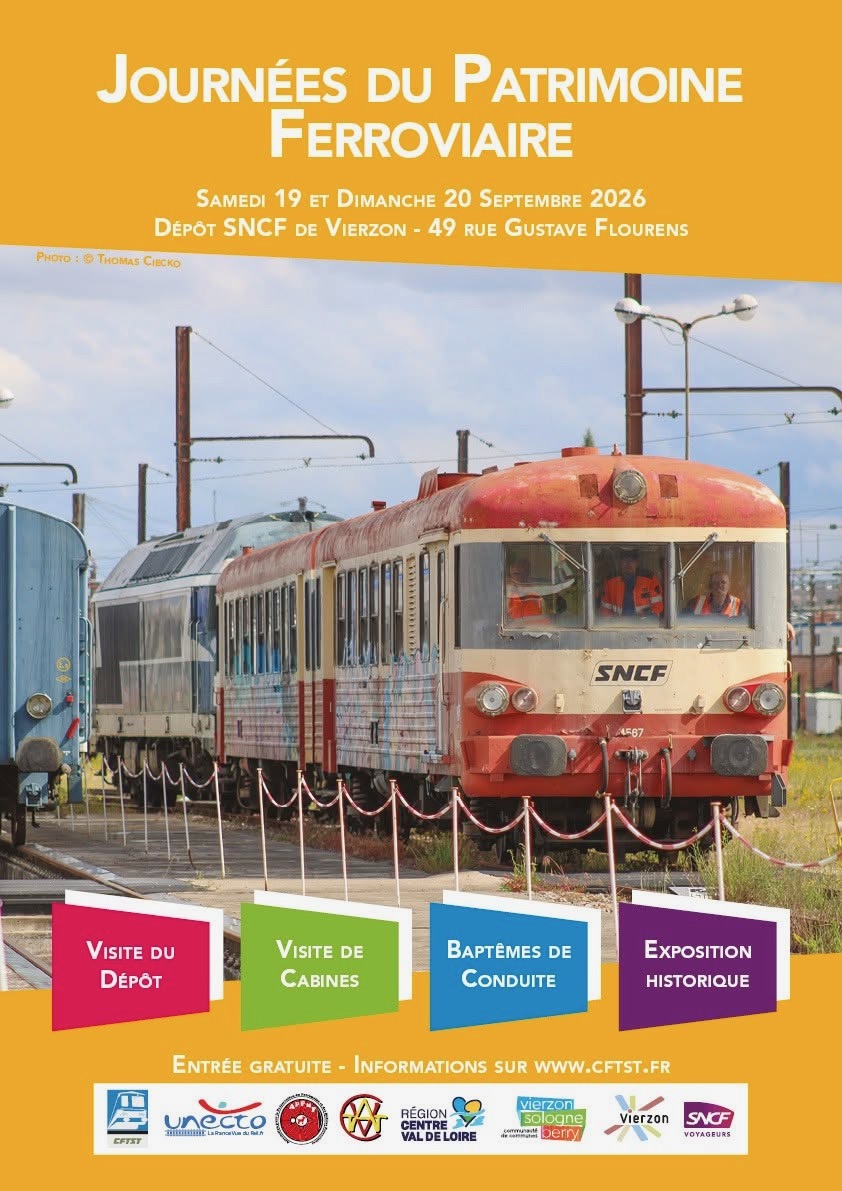
Jours de Patrimoine 2026
This year’s events over the weekend of 18-20 September take the theme Patrimoine en peril, highlighting the effects of climate, war and neglect on 200 years of railway heritage.
SNCF is offering events at 160 locations and opening 16 technicentres to the public.details at: https://www.groupe-sncf.com/fr/groupe/patrimoine-archives/jep-2026
RATP. Many little known aspects of the metro network will be revealed in events, workshop visits, opening of the archives and other activities.
https://www.ratp.fr/decouvrir/patrimoine/journees-europeennes-du-patrimoineVirtually all of the preservation societies will be operating, with many putting on special displays and events. This will include a number of mainline events. Details of all the preservation socieities are available on the UNECTO website. https://www.unecto.fr
Details of a small selection are shown below.





Too darn hot…
Many tourist lines saw their summer services curtailed or stopped altogether on account of fire risk or deformed track. This has major financial implication for small societies that are run on a shoe-string and rely heavily on tourist income during the summer holiday season.
Vélorail operators saw reduced patronage as holidaymakers shunned physical exercise because of the heat. Le Petit Train du Cap-Ferret escaped damage in the fires that led to evacuation of the Cap Ferret peninsula on 23-24 July and was able to continue running . Train de la Rhune was one of several lines that ran evening specials for the eclipse on 12 August; 480 people enjoyed the sight from the summit.
Many tourist lines saw their summer services curtailed or stopped altogether on account of fire risk or deformed track. This has major financial implication for small societies that are run on a shoe-string and rely heavily on tourist income during the summer holiday season.
Vélorail operators saw reduced patronage as holidaymakers shunned physical exercise because of the heat. Le Petit Train du Cap-Ferret escaped damage in the fires that led to evacuation of the Cap Ferret peninsula on 23-24 July and was able to continue running . Train de la Rhune was one of several lines that ran evening specials for the eclipse on 12 August; 480 people enjoyed the sight from the summit.
Others were forced to abandon steam haulage, including the Train des Mouettes whose season had already started late due to the heat which caused postponement of the railway’s 150th anniversary celebrations. It had been hoped to run the event in September, but its cancellation was announced on 28 August. Vapeur de Trieux in Bretagne, whose summer runs were cancelled after only one trip in June, saw September’s stopped too, thus losing the whole season.
At CFHVS Chemin de Fer Historique de la Voie Sacrée Bar-le-Duc No 26 ‘La Suzanne’ was confined to mornings only as steam was banned between 13.00 and 22.00. CFTLP replaced steam on its Limoges – Eymoutiers services with diesel 040 DG 421. Also affected were SABA, Transvap, Abreshviller, CF de Vendée and MTVS.
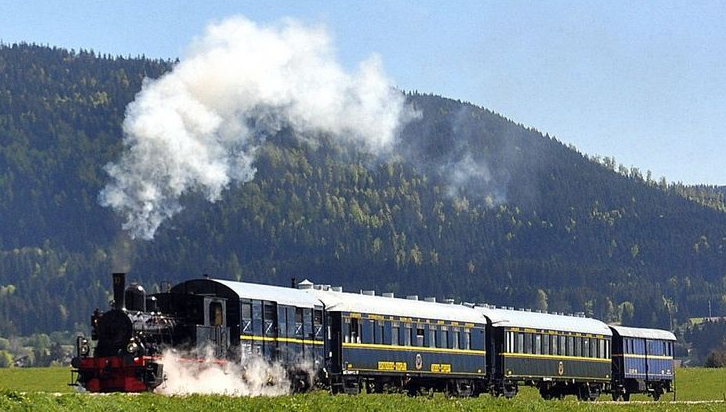
Untroubled was Coni’fer, association Le Chemin de fer touristique Pontarlier-Vallorbe, which launched its summer season on 8 July with return to steam of ‘Tigerli’ Rhône No 5 (SLM 1915) after renovation in Germany. The line runs 8km north from Les Hôpitaux-Neufs on the former Pontarlier – Vallorbe line closed in 1969. Photo: Association Coni’fer.
CFBS were delighted to announce that over two inches of rain had fallen in the Baie de Somme during the latter part of the month and re-introduced full steam operation from Monday 24 August. This was just in time to welcome their 5 millionth passenger in preservation.
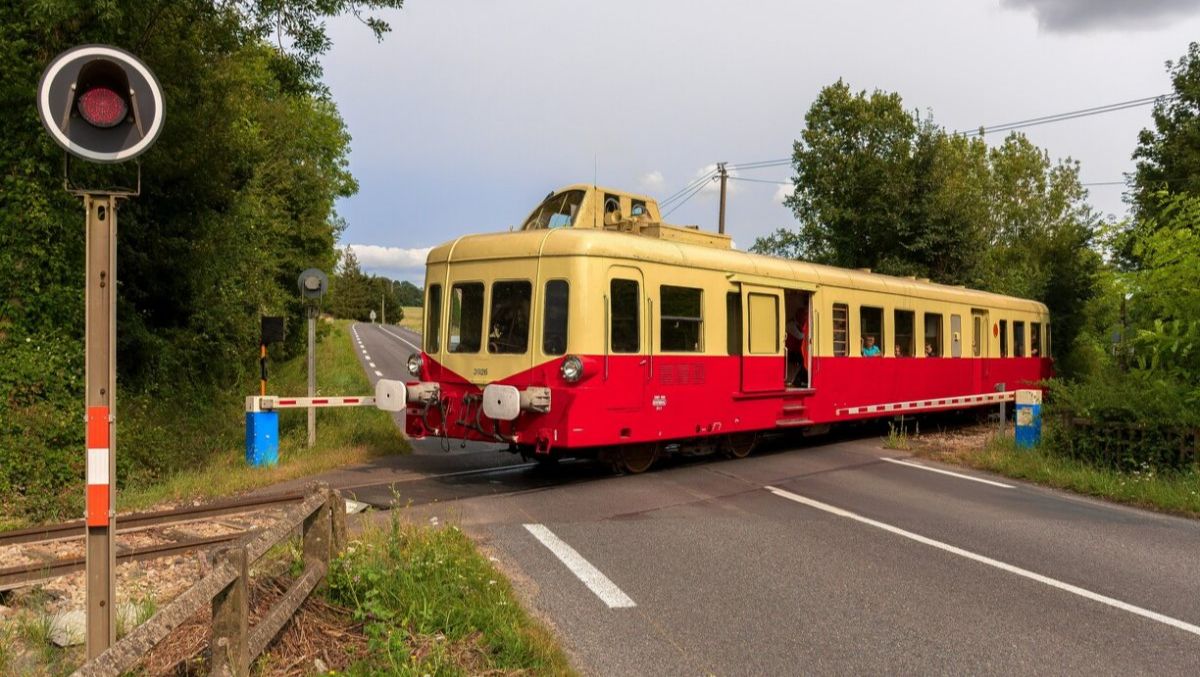
TFBCO Tourisme Ferroviaire de la Brie Champenois à l’Omois in Marne département planned their summer operating season until 4 October. It had to be cancelled after only one trip due to track defects when a Captrain E4000 spread the track between Artonges and Montmirail. A makeshift repair was made with a speed limit of 10km/h imposed. This is sufficient for Captrain to reach the maintenance depot at Montmirail but is unworkable for TFBCO as the journey would take too long and the speed limit would strain the gearbox of their Picasso autorail X 3926.
Operation will resume only after major repairs are completed, something of little interest to Captrain which manages to get through at 10km/h regardless of the state of the track. Photo: TFBCO.
Operation will resume only after major repairs are completed, something of little interest to Captrain which manages to get through at 10km/h regardless of the state of the track. Photo: TFBCO.
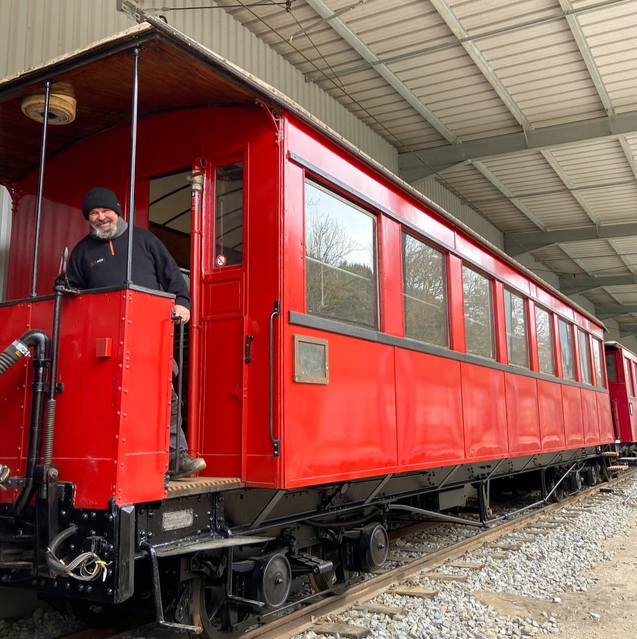
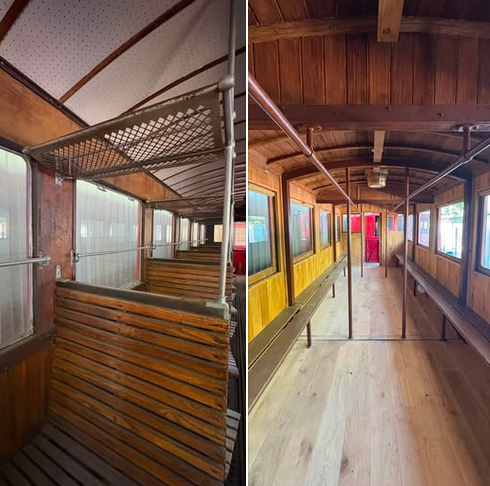
Reporting a better season is Petit train de La Mure where the new general manager Pierrick Géranton, a veteran of several tourist railway operations, is hoping to double the number of visitors. The line has been beset by operating problems in recent years and patronage dropped to 16,000 in 2025. By the beginning of August, 20,000 passengers had been carried against a target for the season of 30,000. Two coaches of 1912 vintage entered service in July, the first to be restored at a cost of €100,000 each from a batch of five that had been languishing in the old workshops at Saint-Georges-de-Commiers (see below). Photos: Petit Train de La Mure.
The original CF de La Mure was severed by a landslide in 2010; the upper section is now the Petit Train de La Mure, while the lower part, managed by Isère département on behalf of the State, opened last year as Vélorail des Alpes. At the old headquarters of Saint-Georges-de-Commiers, the département bought the station site (7Ha) and earlier this year spent €950,000 to restore the buildings. Further work will create a museum of rolling stock and artefacts. Two-thirds of the 135 vehicles on site will be preserved, those in poor condition scrapped. Some stock has gone to Petit Train de La Mure; 21 items were sold for a symbolic €1 to associations including Train de l'Ardèche, Velay Express, Musée du Temps Jadis Besançon, CF du Vivarais, and Asttre19; 36 remain in the care of the commune of Saint-Georges-de-Commiers.
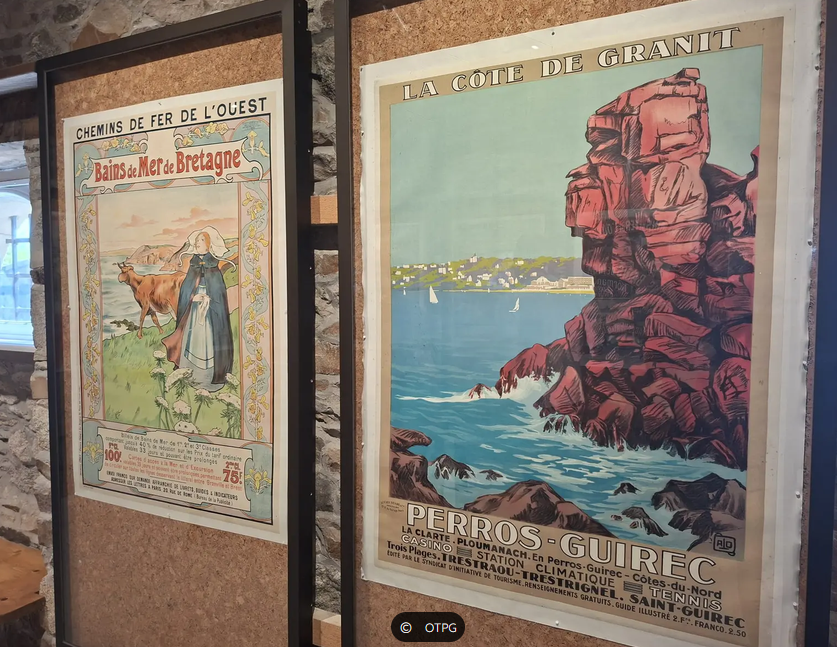
Posters collected by Jacques Khanzadian and his son Cyril are on show at Perros-Guirec in Bretagne where the former Le Linkincapitainerie has been reopened as a museum. Many are by well-known artists working in the genre from the 1890s through to WW2, commissioned by railway companies to promote holiday travel. Photo: © Perros-Guirec Office de Tourisme.
Capdenac-Gare. The local tourist office has drawn up a new guide for visitors to see the best features of this town built by the PO railway, including the art déco station building, marquise with its tinted glazing, railway workers’ houses, preserved Est steam loco, and non-railway items including a scale replica of the Eiffel Tower. The town is also home to Reynal & Roquelaure whose tinned foods were developed from meals originally served at the station buffet. Details at: www.tourisme-figeac.com
Work to preserve remains and artefacts of the Chemin de fer de Grande Banlieue (CGB) in Essonne département has led to creation of association Tacot (the line’s nickname), meeting for the first time on 9 October at 91490 Milly-la-Forêt. Unconnected northern and southern standard-gauge networks extended to 215km in what are today the western suburbs of Paris. Closure started in 1938 and all was gone by 1948. One of the locos, rare bicabine 030T No 103 (Schneider 1925), is preserved at Transvap.
Saint-Agrève. 30 July saw official inauguration of the station building converted into three flats for hikers and cyclists, plus opening of the renovated booking hall for use by Velay Express.
Petite Ceinture. Opening to leisure users of a further short section in the 15arr was approved in August, a 300m tunnel connecting two portions already in use.
Urban News
Major work over nine days last month saw replacement of the bridge at Aubervilliers carrying RER Line B over the Canal Saint-Denis east of La Plaine Stade-de-France station. The 30.5m girder bridge dating from 1900 was removed, the piers raised and two new steel decks lifted into position using a 700tonne crawler crane and high-capacity jacks. NGE and five of its subsidiaries handled the task for SNCF Réseau, a total of 2,800h hours’ work since June last year. RER B service resumed on 17 August, although disruption continues due to work elsewhere. Photo: NGE.
Nice operator Line d’Azur is facing similar charges concerning ‘fictitious jobs, unjustified paid leave and misuse of public funds’. Complaints have been made to the local public prosecutor and the national Financial Prosecutor.
Paris tramway. Île-de-France Mobilités has approved two tramway extensions: T7 between Athis-Mons Porte d’Essonne and Juvisy-sur-Orge and T10 from Jardin Parisien to Clamart. The first €110 million tranche of funds for T7 was granted last December. Now, a further €100 million has been agreed, split between the State (36%), ÎdF région (49%) and Essonne département (15%), ready for award of construction contracts following the start of preliminary works in June. The 3.7km will have six stops; opening 2032. T10 will be extended 3.8km north, underground with stops at Mairie-de-Clamart, Centre-de-Clamart Victor-Hugo and Gare de Clamart, connecting there with GPE Line 15 and Transilien Line N. Its main purpose is to relieve bus routes 189 and 191; cost €730 million.
Navigo annual tickets became downloadable to smartphones via ÎdFM’s 10.0 app on 11 August, when a selected 1% of passholders began using it. Access will open to all holders in the coming weeks as feedback confirms the integrity of the system, with 1.3 million eventually benefiting. Once downloaded, the physical card is invalidated but can be reactivated if users change their mind.
RATP saw half-year profit cut to €81 million from €153 million in 2025, with Ebitda falling 29% to €160 million. Turnover increased by 1.2%, driven by the results of subsidiaries in France and abroad which now account for 38% of group activity.
Lyon Line D. Modernisation of the world’s first large-profile driverless metro enters a new phase on 7 September with evening closures lasting until the end of December. Line D, now 45 years old and the city’s busiest, is being rebuilt for four-car trains and the obsolete Maggaly automation system replaced. Alstom is supplying 26 MLP25 four-car trains and installing its Urbalis 500 automation system, including cybersecurity technology. Work includes upgrade of the track protection that allows the line to operate uniquely without platform-screen doors, and expansion of Thioley depot to accommodate the additional trains.
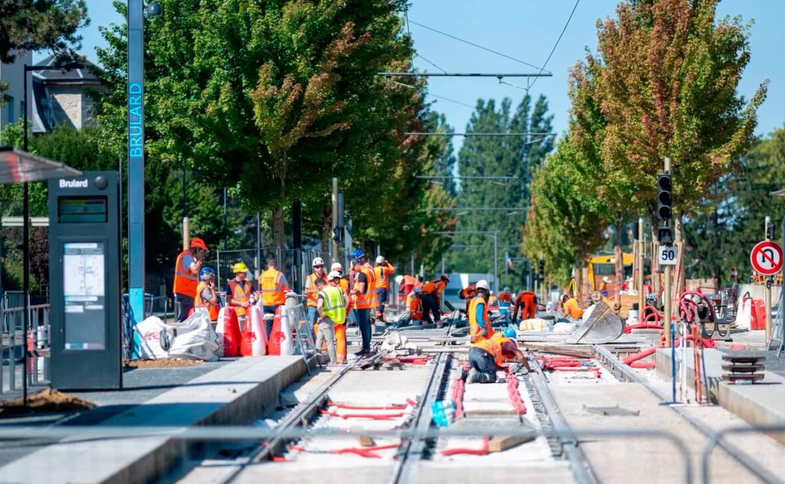
Besançon. Construction of a turnback siding at Brulard over the summer allows rearrangement of the two routes. From 15 October, T1 will be cut back to run Chalezeule – Brulard every 8min, while T2 runs Hauts-du-Chazal to Gare Viotte at 5min intervals. On the common section between Parc Micaud and Brulard there will be a 3min service. Cost of the work is €3.5 million. Photo: Ville de Besançon/CB.
Preparatory work for construction of Caen T4 accelerated over the summer whilst road traffic was reduced. One of the jobs involved repositioning the athletics track at Lycée Malherbe by 5m to make way for the new alignment past the school. Opening in 2029, T4 will link Presqu’Île (T2) in the city centre with western suburbs, splitting at Hôtel de Ville for Saint-Constant and Pompidou; 9.1km of new alignment, 17 stops, three park-and-rides.
Annemasse. Start of trial running on the new section of Geneva’s T17 was delayed on account of security measures imposed around the G7 Summit held at Évian-les-Bains in June, pushing back the opening date from 1 September to 17 October.
Nice T5 from Palais des Expositions to Drap was declared to be of public utility on 27 July, clearing the way for land acquisition. The 7.6km route with 15 stops, opening by 2031, is expected to carry 45,000 passengers daily; cost €376 million. The last Citadis 302 tramcar of T1 to be lengthened to 44m was outshopped in July. Alstom supplied additional sections to extend the remaining 13 sets, raising capacity from 216 to 295 passengers.
Preparatory work for construction of Caen T4 accelerated over the summer whilst road traffic was reduced. One of the jobs involved repositioning the athletics track at Lycée Malherbe by 5m to make way for the new alignment past the school. Opening in 2029, T4 will link Presqu’Île (T2) in the city centre with western suburbs, splitting at Hôtel de Ville for Saint-Constant and Pompidou; 9.1km of new alignment, 17 stops, three park-and-rides.
Pont d’Alouette road bridge in southern Tours was demolished over the weekend of 25-26 July in preparation for rebuilding to accommodate tracks of T2 under construction between La Riche and Chambray-lès-Tours, 12.6km, 22 stops, opening in 2028.
Strasbourg. The flat crossing at Homme de Fer was replaced overnight on 10-11 August while other works continued until the 29th. Lines A, B, C, D and F were interrupted.
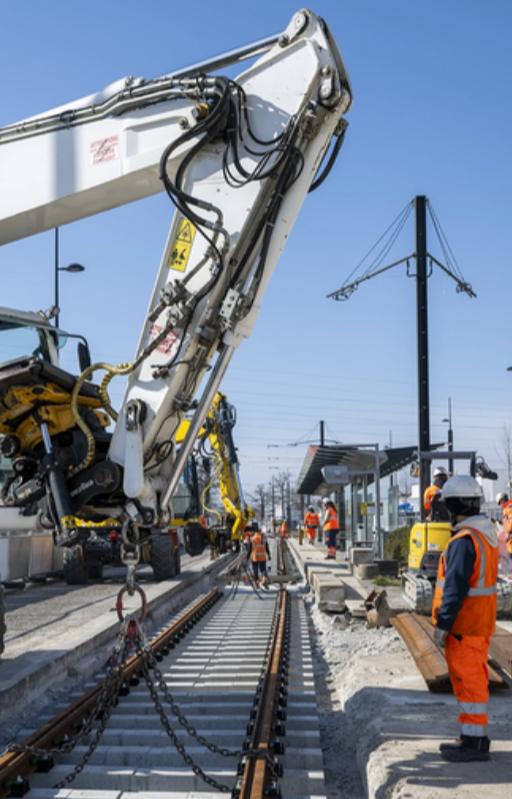
Nantes. T1 was closed in the city centre from 14 June until 30 August for reconstruction of 1.2km of track between Médiathèque and Gare Maritime, replacing the outdated ‘Dortmund’ track with Nantes’ own system. OHL was also renewed, with masts at each side instead of between the tracks. The three stops have been modernised, Médiatheque rebuilt and Chantiers Naval equipped with a new design of shelter which is to become the network standard.
Photo: Semitan.
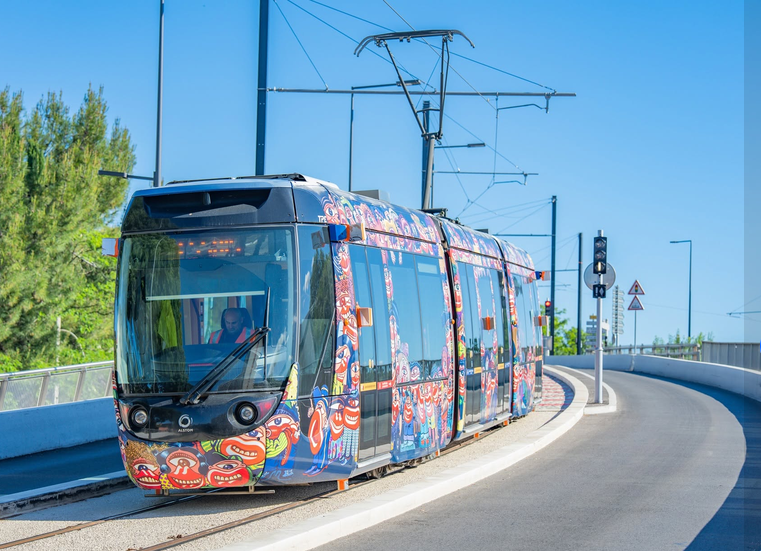
The 13.2km Val’tram from Aubagne to La Bouilladisse, which was to open this summer, will not now be ready before January. Métropole Aix-Marseille-Provence said the tight construction timetable had been unable to absorb several setbacks including theft of materials from worksites. Trials have been underway for several months; simulated timetable operation and driver training start shortly. Delivery of four additional cars from Alstom is also behind schedule. Despite the métropole’s budget crisis, Aubagne’s maire considers free travel on the existing short route in the town, costing €1.3 million a year, as “a red line not to be crossed”. Locals are waiting to hear whether Val’tram will be similarly fares-free. Photo: Ville d’Aubagne.
The 6km extension of Geneva’s T15 across the border to Saint-Julien-en-Genevois (1.4km in France with three stops) has been put on hold by the Swiss administrative court as the route encroaches on agricultural land without adequate compensation. Consultations will seek a solution for the long-discussed link unlikely to open before 2032.
Additions to FRS Photographic Archive during August 2026
To Photographic section
To Locations section
Additions to the FRS public folder during August 2026
- None
To Locations section
- None
Additions to the FRS public folder during August 2026
- LVDR 1495/July 1975 on 'New banlieu DD coaching stock'
- LVDR 1505/August 1975 on 'Amiens/Calais'
- LVDR 1841/April 1982 on '150 years of French railways'
- LVDR 2316&2317/October 1991 on 'Accident at Melun'

© Peter Lovell & Chris Bushell. The French Railways Society 2026. With thanks to Georges Turpin, Christophe Masse, Gwenaël Piérart, Pierre Julien and Philippe Leynaud